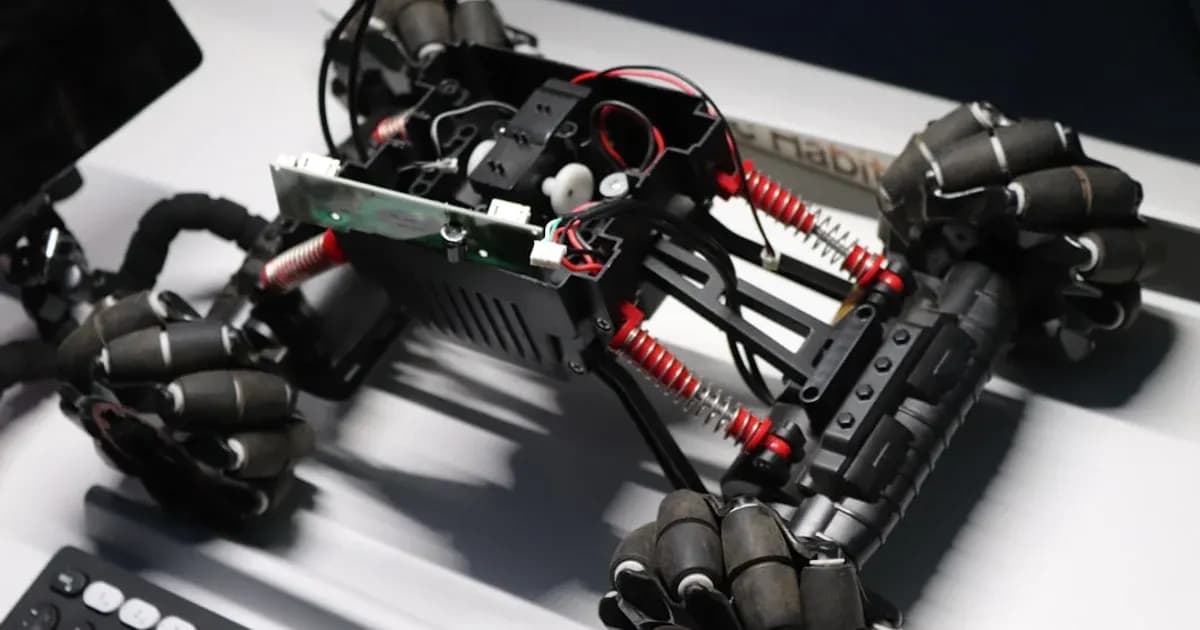
A New Efficiency Standard for Physical AI
The efficiency imperative in industrial automation has reached a critical juncture. Recent developments in neuro-symbolic AI indicate a potential to reduce energy consumption for robotic agents by up to 100 times, concurrently boosting accuracy. This engineering advancement, highlighted by research published on ScienceDaily, alters the operational calculus for AI engineers and machine learning architects, especially those deploying AI at the edge.
This is not a marginal gain. It is a re-architecture of how AI perceives, reasons, and acts in the physical world. For industries reliant on precise, continuous operation, the implications of such a leap are profound.
The Architectural Advantage of Neuro-Symbolic Systems
Traditional deep learning models, while excelling at pattern recognition, often consume significant computational resources. Their end-to-end, data-driven nature requires extensive training data and substantial inference power, especially for complex tasks demanding reasoning beyond mere correlation. When deployed as Visual-Language-Action (VLA) models in robotics, this translates to high energy demands and sometimes brittle performance in novel scenarios.
Neuro-symbolic AI addresses this by fusing two distinct paradigms: the perceptual capabilities of neural networks and the logical precision of symbolic systems. Neural components handle tasks like image recognition, natural language understanding, and raw sensor data processing. Symbolic components, on the other hand, encode explicit knowledge, rules, and logical relationships. This structure allows the system to perform complex reasoning, planning, and decision-making that pure neural networks struggle with.
The efficiency gain stems from several factors. Instead of a neural network attempting to implicitly learn complex physical laws or operational sequences from massive datasets, a symbolic reasoning engine provides these rules explicitly. This guidance significantly prunes the search space for the neural components, allowing them to focus on perception within a well-defined context. For instance, in a manufacturing setting, a neural network identifies a component, but a symbolic rule dictates the precise assembly sequence or quality standard. This reduces the need for over-parameterized models and minimizes redundant computation during inference.
Consider an industrial robot tasked with object manipulation. A purely neural system might require millions of examples to generalize to varying object poses and environmental conditions. A neuro-symbolic system uses a neural network for visual identification (e. G., detecting a specific gear), but a symbolic knowledge base contains geometric properties of the gear and rules for its insertion. The symbolic part guides the neural system's attention, enabling faster, more accurate recognition with fewer inferences. This architectural choice inherently reduces the computational load, leading directly to lower energy use and faster decision cycles. A 2023 study by researchers at Google DeepMind and MIT demonstrated how symbolic representations can make learning more sample-efficient and interpretable, which translates directly to efficiency in deployment.
Implications for Industrial Automation and Edge Deployment
For organizations operating critical infrastructure and industrial processes, the implications of neuro-symbolic robotics are transformative. The reduced energy footprint directly translates to lower operational costs. And, the ability to deploy complex AI logic on edge devices with constrained power and compute resources becomes feasible. This is particularly relevant for real-time applications where data cannot leave the operational site due to latency or security concerns.
Enhanced Reliability and Explainability
Integrating symbolic reasoning provides a degree of explainability often absent in black-box neural networks. When a robotic agent makes a decision, the symbolic rules governing that decision can be inspected and debugged. This transparency is crucial for high-stakes industrial environments where auditing and compliance are paramount. For example, if a quality inspection robot flags a defect, the system can articulate *why* it did so, referencing specific rules and visual features, rather than just outputting a probability score. This directly aligns with the objectives of Shreeng AI's industry-ai offerings, where precision and accountability are non-negotiable.
Broader Application Scope
The improved efficiency and logical capabilities enable new possibilities for automation. Tasks previously deemed too complex, too variable, or too energy-intensive for AI are now within reach. Examples include:
* **Precision Manufacturing:** Robots performing intricate assembly operations or material handling in dynamic environments, adapting to minor variations in parts or tooling without retraining. * **Automated Quality Control:** Systems like Shreeng AI's quality-inspection platform can use neuro-symbolic architectures to identify defects with greater accuracy and fewer false positives, learning from explicit defect criteria rather than solely from vast image datasets. * **Predictive Maintenance:** AI agents monitoring machinery can use neural networks to detect subtle anomalies in sensor data, while symbolic rules interpret these anomalies within the context of machine operational states and maintenance schedules. This directly enhances platforms such as Shreeng AI's predictive-maintenance solution, enabling more precise forecasting of equipment failures and optimizing maintenance schedules. * **Logistics and Supply Chain:** Autonomous mobile robots (AMRs) navigating complex warehouse environments, dynamically planning routes, and handling diverse inventory based on logical rules and real-time visual input. A report by McKinsey & Company indicates that neuro-symbolic AI can significantly improve decision-making in complex logistical systems.
And, the reduced reliance on massive, labeled datasets for training means faster deployment and adaptation. Organizations can encode domain expertise directly into the symbolic layer, reducing the need for costly and time-consuming data collection and annotation efforts. This accelerates the path to value for new automation initiatives.
Shreeng AI's Position: The Future is Architected Logic
Shreeng AI holds that the efficiency gains from neuro-symbolic AI are not merely an incremental improvement; they signify a fundamental architectural shift required for the next generation of industrial automation and physical AI agents. The current trajectory of purely data-driven, monolithic models is unsustainable for many real-world, edge-deployed applications due to their computational hunger and lack of inherent reasoning.
We see neuro-symbolic approaches as central to developing truly autonomous, reliable, and energy-conscious industrial AI. This paradigm enables AI systems to not only perceive their environment but also understand it within a framework of explicit rules and knowledge. This capability is critical for applications demanding high levels of trust, safety, and adaptability, where an AI system must operate not just effectively, but also transparently.
Our work in automation-ai and ai-video-intelligence is actively integrating these principles. By combining perception with reasoned action, we create solutions that are not only efficient but also context-aware and logically grounded. This means AI agents that perform tasks with rare precision, consume less energy, and provide clear justifications for their actions. The future of industrial AI will be defined by systems that can reason as effectively as they perceive, and neuro-symbolic architectures provide the blueprint for that future. The deployment of these complex systems requires a deep understanding of both neural network engineering and symbolic logic, a blend of expertise Shreeng AI provides.
Sources
- https://vertexaisearch.cloud.google.com/grounding-api-redirect/AUZIYQFCOMRLwrjswZV6SyMXMXyQjBPZlEeCVNXXRcxqp_n4o682OgQ3kamTkK0VfuBtgTqlxOqMtrEQz5AbfzEtPnvNXNvOvt7wfoIiJeEXsAvsOwtXmc6ASBzNncZ6qZ3x_lNzchdB3q_6UUWFIKS4cwasNRC4-hle_m3
- https://deepmind.google/discover/blog/neuro-symbolic-ai-for-reasoning-and-learning/
- https://www.mckinsey.com/capabilities/quantumblack/our-insights/the-next-frontier-of-ai-neuro-symbolic-ai
Rohan Kapoor
Head of Computer Vision
Specializes in real-time video analytics, object detection, and visual inspection systems for industrial environments.