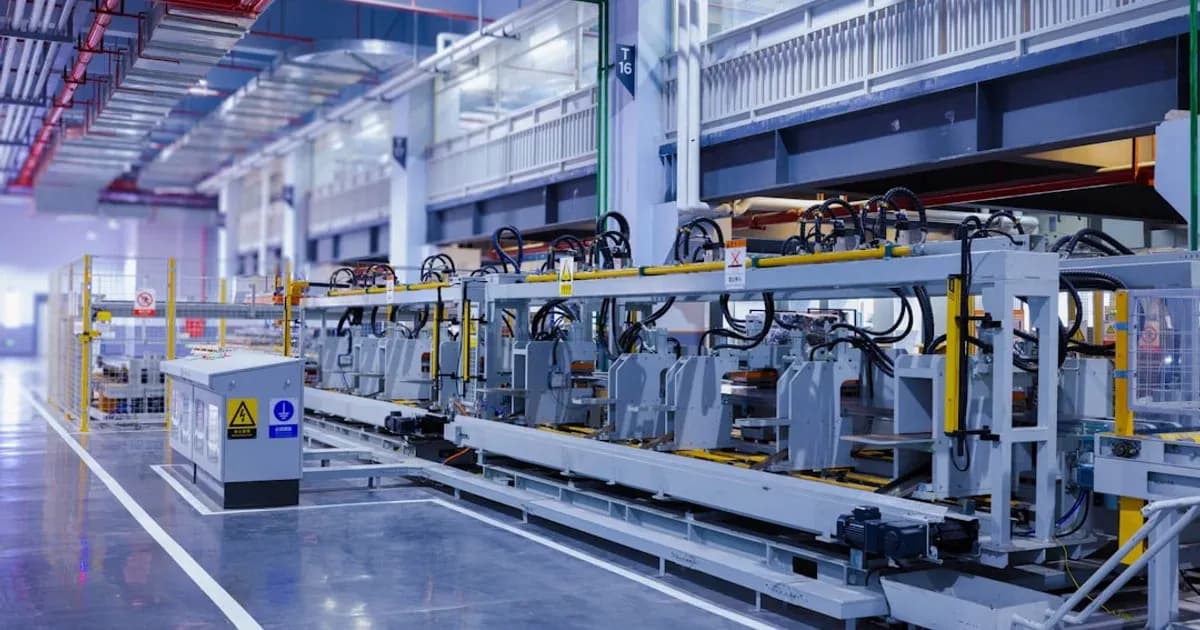
Manufacturers are transitioning AI from isolated pilots to full operational deployment, especially in critical areas like real-time quality inspection and dynamic production planning. This marks a significant shift from experimental projects to enterprise-wide integration. A recent 2024 industry analysis from the Manufacturing Leadership Council notes that 58% of global manufacturing enterprises are actively deploying AI solutions beyond initial proof-of-concept stages. For instance, a major automotive manufacturer recently reported a 15% reduction in assembly line defects by deploying vision AI for real-time component verification, directly impacting yield rates and rework costs. Similarly, a chemical processing plant optimized energy consumption by 7% through AI-driven dynamic process control. This move from contained tests to full production environments signifies a maturation in how industry perceives AI's utility. The focus is now on realizing sustained operational gains, not merely proving technical feasibility or demonstrating isolated capabilities. The imperative is clear: AI must move from the lab bench to the factory floor, delivering measurable economic value.
Why is this transition happening now, and what prevents its widespread success? The underlying drive is competitive necessity. Global supply chains demand agility, and consumer expectations push for zero-defect production. Yet, the primary bottleneck for achieving scalable, plant-wide AI impact and return on investment lies in overcoming fragmented data silos and disconnected operational systems. This demands a coherent data strategy for successful implementation. Without it, the promise of AI remains largely unfulfilled.
Consider the typical manufacturing data landscape. Production lines generate vast volumes of sensor data from IoT devices, machine logs from programmable logic controllers (PLCs), and quality control reports from vision systems. Enterprise Resource Planning (ERP) systems hold inventory, procurement, and financial records. Manufacturing Execution Systems (MES) manage work orders, production schedules, and labor tracking. Computer-Aided Design (CAD) and Product Lifecycle Management (PLM) systems store design specifications and engineering changes. These systems often operate in isolation, managed by different departments with distinct objectives. They use disparate data formats, communication protocols, and access controls. An AI model for predictive maintenance, for example, requires historical machine sensor data, maintenance logs, environmental conditions, and production schedules. If this information resides in five different systems, each with its own schema, API, and access permissions, data preparation becomes an insurmountable, repetitive task. This prevents models from being trained on a comprehensive view of operational reality.
The Pervasive Challenge of Data Quality and Governance
The challenge extends beyond mere integration. Data quality is another critical barrier. Sensor drift, missing values, inconsistent timestamps across different data streams, or incorrect labeling render datasets unusable for training accurate AI models. A visual inspection system might capture millions of images from a production line, but if these images lack consistent, accurate annotations identifying specific defect types, or if they are not correlated precisely with product batch numbers and environmental conditions, they are noise, not data. Manufacturing data is often noisy, incomplete, and lacks uniform contextual metadata.
Data governance frameworks are frequently absent or insufficient within manufacturing environments. This leads to a lack of clarity on data ownership, access rights, and lifecycle management. Who is responsible for the integrity of temperature readings from a specific oven? How long should historical machine performance data be retained, and in what format? Without standardized metadata, documented data lineage, and clear data dictionaries, data scientists often spend 80% of their time on data cleaning and preparation. This delays model development, inflates project costs, and diverts expertise from higher-value tasks like feature engineering or model optimization. A 2023 study by Deloitte found that poor data quality costs manufacturers an average of 15% of their annual revenue in inefficiencies and lost opportunities.
The consequence is that even successful pilot projects struggle to scale. A proof-of-concept might run on a carefully curated, small dataset, perhaps for a single machine or product variant. But expanding to an entire factory, with hundreds of machines, diverse product lines, and shifting operational parameters, exposes the fragility of an unmanaged data environment. The cost of manual data wrangling for full-scale operations becomes prohibitive. This prevents the continuous retraining and improvement essential for AI systems to maintain performance in dynamic manufacturing environments. It also limits the ability to generalize models across different production lines or facilities, hindering enterprise-wide standardization and efficiency gains.
The Cost of Fragmented Data: Lost Potential
The implications for manufacturers are significant and increasingly urgent. Organizations failing to address their data fragmentation will find their AI initiatives stagnating, perpetually stuck in pilot purgatory. They will struggle to move past small, isolated successes, failing to realize the promised enterprise-wide transformation. This translates directly into lost competitive advantage. Competitors with a cohesive data strategy can deploy AI faster, optimize production more effectively, and bring higher-quality products to market at a lower cost. A 2025 report by PwC projected that manufacturers with mature data strategies could achieve a 2.5x higher ROI from AI investments compared to their peers.
And, the lack of a unified data foundation severely hinders comprehensive decision-making. AI models operating on siloed data can optimize individual processes, but they cannot provide the enterprise-wide visibility needed for strategic choices. For instance, optimizing machine uptime without considering fluctuating customer demand, raw material availability, or energy price volatility leads to suboptimal inventory levels and increased operational expenditures. This creates inefficiencies elsewhere in the value chain, eroding the very gains AI aimed to provide. Decision intelligence relies on a comprehensive view of operations, which is impossible without integrated, high-quality data. The promise of Industry 4.0 — autonomous factories, self-optimizing supply chains, and adaptive production systems — remains a distant vision without this fundamental data unification. The investment in AI technologies yields minimal return when the underlying data infrastructure cannot support their demands, much like planting a seed in barren soil.
Shreeng AI's Position: Data Strategy as the Foundation
Shreeng AI holds that scalable manufacturing AI deployment is not primarily a model-building challenge; it is a data strategy challenge. The path from pilot to production requires a deliberate, architectural approach to data collection, integration, governance, and accessibility. We advocate for a unified data fabric that serves as the backbone for all industrial AI applications. This architecture must connect disparate operational technology (OT) and information technology (IT) systems. It must standardize data formats, ensure data quality, and establish clear governance protocols across the entire value chain.
Implementing real-time quality inspection with AI, for example, demands streaming data from high-resolution cameras, synchronized with production line telemetry, product specifications, and batch identifiers. This requires a complex data pipeline that can ingest, process, and store petabytes of visual and sensor data efficiently, often at the edge of the network. Without a pre-defined data strategy and the infrastructure to support it, each new AI deployment becomes a bespoke, labor-intensive integration project, unsustainable at scale. This leads to project delays, cost overruns, and, abandoned initiatives.
Building the Data Foundation for AI Success
Our approach centers on building foundational data capabilities before layering on AI applications. This includes developing flexible data ingestion frameworks that can handle diverse industrial protocols like OPC UA, Modbus, and MQTT, alongside enterprise APIs. It means establishing data lakes or data warehouses specifically optimized for time-series, visual, and transactional data, ensuring data freshness and accessibility. Critically, we implement metadata management systems and data catalogs that provide a single source of truth for all operational data, detailing its origin, transformation, and usage.
Only with this reliable data foundation can organizations truly benefit from purpose-built solutions. Consider Shreeng AI’s AI Quality Inspection. This system detects minute defects on assembly lines by processing camera feeds in real time. Its effectiveness hinges on continuous access to correctly labeled training data and real-time operational context. Without a streamlined data strategy, the model's accuracy would degrade as product specifications change or new defect types emerge, necessitating costly manual recalibration. Similarly, our Predictive Maintenance Platform aggregates machine health data, operational parameters, and historical failure records from across the factory floor to forecast equipment breakdowns with precision. Such platforms require access to clean, labeled, and continuously updated datasets to train and refine their models, ensuring high uptime and reducing unplanned outages.
Shreeng AI’s `industry-ai` solutions directly address these architectural needs, enabling manufacturers to move beyond fragmented pilots to enterprise-wide impact. We focus on creating a cohesive data environment that fuels continuous learning and adaptation for AI models. Our `decision-intelligence` framework then use this unified, high-quality data to provide actionable insights, moving organizations from reactive problem-solving to proactive, evidence-based strategy. This institutional conviction is not merely about deploying isolated AI tools. It is about transforming the entire operational data landscape to enable pervasive, impactful AI across the manufacturing enterprise. The future of manufacturing AI, and the realization of its full economic potential, depends on how effectively enterprises manage their data today. Those who prioritize a comprehensive data strategy will lead the next wave of industrial transformation.
Sources
- Manufacturing Leadership Council: Industry AI Outlook 2024 (https://www.manufacturingleadershipcouncil.com/industry-ai-outlook-2024)
- Deloitte: Manufacturing Data Strategy (https://www2.deloitte.com/us/en/insights/industry/manufacturing/manufacturing-data-strategy.html)
- PwC: AI Investment ROI in Manufacturing (https://www.pwc.com/gx/en/industries/manufacturing/ai-investment-roi.html)
- Manufacturing Trends: AI Scaling Report (https://www.manufacturingtrends.com/ai-scaling-report)
Siddharth Patel
Head of Predictive Systems
Builds forecasting engines and early-warning systems for operations, finance, and supply chain use cases.