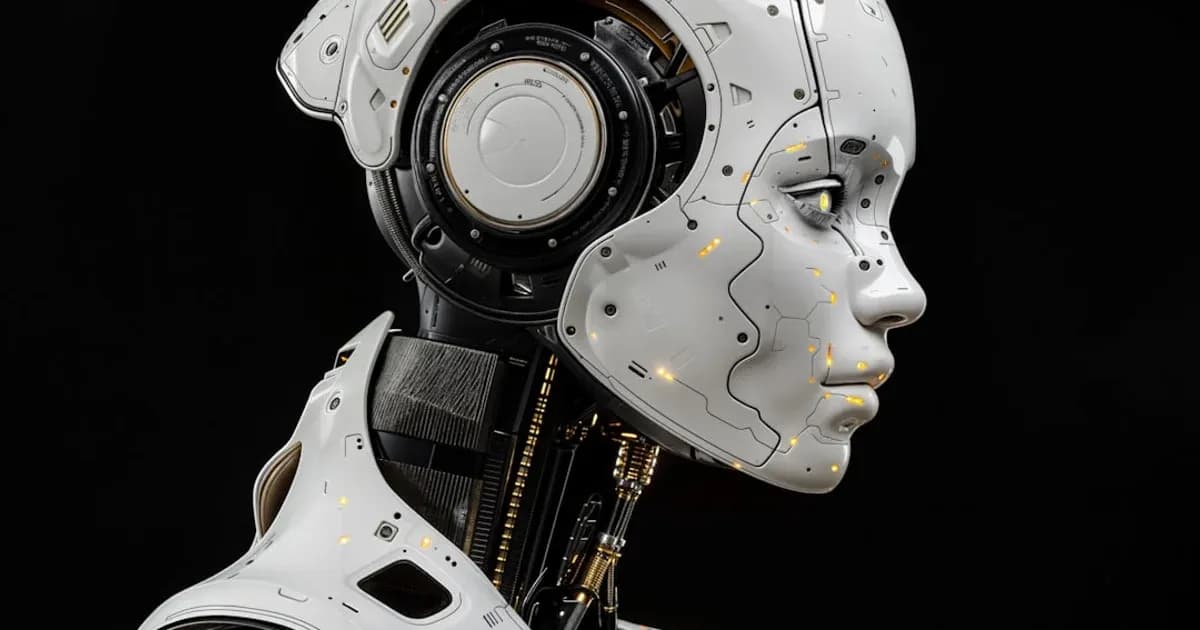
Humanoid Robots Validate Industrial AI: From Lab to Production Line
Observation: Humanoids Enter the Factory Floor
In late 2025, Figure AI demonstrated its Figure 01 humanoid robot executing tasks requiring fine motor control and perception on actual BMW factory floors. This followed Boston Dynamics' Atlas performing intricate manipulation tasks within simulated industrial settings, now moving towards live operational lines. These are not isolated lab experiments. These are verifiable instances of humanoid robots performing complex, previously human-only tasks in industrial contexts. The shift from controlled laboratory environments to real-world production lines marks a significant moment for physical AI, validating years of research and investment. This is the tangible outcome of decades spent refining robotics and artificial intelligence, converging into a practical, deployable solution.
Traditionally, industrial automation relied on fixed-arm robots executing highly repetitive, pre-programmed movements. Such systems excelled at volume and precision within narrowly defined parameters. But they lacked the adaptability, dexterity, and cognitive awareness needed for tasks requiring nuanced interaction with unstructured environments or variable materials. The current wave of humanoid robot demonstrations addresses this gap directly, showcasing the ability to navigate dynamic spaces, manipulate diverse objects, and even identify subtle defects, all without extensive re-programming for each new scenario. It is a fundamental evolution in how we conceive of automated industrial labor.
Analysis: The Engines of Embodied Intelligence
The ability of humanoid robots to operate effectively in complex industrial settings stems from a convergence of specific technological advancements. This isn't just about faster processors or better motors; it is about the intelligent integration of perception, planning, and action, underpinned by complex AI models and simulation architectures.
#### Physical AI and Dexterous Control
At the core of these capabilities lies physical AI, a domain that fuses machine learning with biomechanics and control theory. Humanoid robots use deep reinforcement learning to acquire complex motor skills. Instead of explicit programming for every joint movement, agents learn optimal policies through trial and error, often in vast simulated environments. This process allows them to develop highly dexterous control over multi-degree-of-freedom manipulators, mimicking human-like grasping, lifting, and precise placement. Consider the challenge of picking up a delicate, irregularly shaped component from a bin. This demands real-time visual assessment, force feedback interpretation, and adaptive grip. Traditional robots struggle; humanoids, with their learned physical intelligence, approach this with greater fluidity.
Sensor fusion plays a central role. High-resolution cameras provide visual input for object recognition and pose estimation. Lidar and depth sensors map the environment, allowing for obstacle avoidance and navigation. Force-torque sensors in the wrists and fingertips convey tactile information, enabling delicate manipulation and preventing damage to components. An array of these sensors feeds into perception models, providing the robot with a comprehensive understanding of its physical surroundings and the objects within it. This integrated sensory feedback Loop is crucial for the adaptive behaviors observed in industrial settings. According to a 2024 report by ABI Research, the market for humanoid robots will reach $38 billion by 2035, driven by advancements in locomotion and manipulation.
#### Simulation-to-Reality (Sim2Real) Transfer
The bridge between training AI in virtual worlds and deploying it in physical factories is the simulation-to-reality pipeline. This critical technology allows AI models to learn millions of interactions in high-fidelity physics simulators like NVIDIA Isaac Sim or MuJoCo. These virtual environments replicate real-world physics, material properties, and environmental conditions with remarkable accuracy. Training an AI agent in simulation offers several advantages: it is safer, faster, and infinitely scalable, allowing for rapid iteration and exploration of diverse scenarios that would be impractical or dangerous to conduct with physical robots.
Domain randomization is a key technique within Sim2Real. By varying parameters like lighting, textures, object positions, and even small physical properties within the simulation, the AI model learns to generalize across different conditions. This makes the trained policy more resilient when transferred to the unpredictable variables of a real factory floor, where lighting changes, objects shift, and dust accumulates. Once a policy is learned in simulation, it can be deployed to a physical robot with minimal fine-tuning. This dramatically reduces development cycles and the cost of deploying new robotic capabilities. A study published in Science Robotics in 2023 highlighted the efficacy of sim-to-real methods for complex manipulation tasks, achieving 90% success rates on real hardware after purely simulated training.
#### Precision Perception for Quality Inspection
For tasks like quality inspection, computer vision systems are paramount. Humanoid robots are equipped with AI-powered vision systems that go beyond simple object detection. They employ deep learning models, including Convolutional Neural Networks (CNNs) and Vision Transformers, to analyze high-resolution images for microscopic defects, surface anomalies, and precise dimensional verification. For instance, inspecting a circuit board for solder joint integrity or a machined part for hairline fractures demands sub-millimeter precision. The AI must distinguish between acceptable variations and critical flaws, often under dynamic conditions.
Systems like Shreeng AI's AI Quality Inspection product integrate these vision capabilities. They process camera feeds in real time, comparing observed features against CAD models or golden samples to identify deviations. This requires not only accurate image capture but also complex algorithms for feature extraction, anomaly detection, and classification. The ability of humanoid robots to precisely position their cameras, change viewing angles, and even use specialized illumination (e. G., structured light, thermal imaging) enhances the effectiveness of these inspection processes. They can navigate around large components, inspect from multiple perspectives, and even interact with the part to reveal hidden defects, a capability fixed cameras lack.
#### Autonomous Decision-Making with AI Agents
These robots function as physical Enterprise AI Agents. They interpret high-level commands, plan complex sequences of actions, and adapt their behavior based on real-time feedback. This is a departure from traditional programmed automation. An AI agent might receive a command like “inspect all widgets on assembly line 3 for surface defects.” The agent then autonomously navigates to the line, identifies the widgets, determines the optimal inspection path, executes the visual scans, and flags any anomalies. This involves: localization and mapping, path planning, obstacle avoidance, grasp planning, and dynamic task prioritization. They can also learn from human demonstrations, accelerating their integration into existing workflows.
AI agents are not merely executing pre-defined scripts; they are making informed decisions within their operational context. If a tool is misplaced, the agent can recognize the deviation and potentially retrieve another. If a defect is ambiguous, it can flag the item for human review while continuing with other tasks. This level of autonomous decision-making, driven by mature planning algorithms and real-time inference, allows for greater operational flexibility and resilience in manufacturing environments. A report by IDC in 2024 projected that AI-driven automation, including physical agents, would contribute over $15 trillion to the global economy by 2030, citing efficiency gains and new capabilities across industries.
Implication: Tangible Value and Operational Transformation
The verified successes of humanoid robots in industrial settings carry significant implications for organizations across manufacturing, logistics, and beyond. This is not about speculative future concepts; it is about delivering measurable business value today.
#### Driving Tangible ROI and Operational Efficiency
Deploying humanoid robots for tasks like quality inspection, material handling, and assembly directly translates into improved operational metrics. Consider quality control: AI-powered visual inspection systems can identify defects with greater consistency and speed than human operators, reducing false positives and false negatives. This leads to lower scrap rates, fewer product recalls, and enhanced brand reputation. For example, a major automotive manufacturer leveraging AI for paint inspection reported a 15% reduction in rework costs within 18 months. Such systems also operate continuously, without fatigue or diminishing attention, ensuring consistent quality across all shifts.
Beyond quality, humanoids address labor shortages in critical areas. They can perform monotonous, physically demanding, or hazardous tasks, freeing human workers for roles requiring creativity, problem-solving, and complex decision-making. This reallocates human capital to higher-value activities. The financial impact extends to reduced operational expenditure through optimized resource utilization and minimized waste. The Boston Consulting Group estimates that robotics and AI can boost manufacturing productivity by up to 30% by 2030.
#### Reshaping the Industrial Workforce
The integration of humanoid robots alters the nature of industrial work. This is not about replacing human labor wholesale; it is about augmenting human capabilities and transforming job roles. Operators will transition from manual task execution to supervising fleets of robots, managing exceptions, and optimizing AI workflows. New roles will emerge in robot maintenance, AI training, and human-robot collaboration design. The demand for skills in AI, data science, and robotics engineering will intensify.
Humanoid robots enhance workplace safety by taking on tasks in hazardous environments – think chemical plants, nuclear facilities, or construction sites with falling debris. They can also mitigate the physical strain on human workers by handling heavy lifting or repetitive motions that lead to musculoskeletal injuries. This leads to a healthier, more engaged workforce focused on strategic contributions. The interaction between human and robot will become a critical interface, requiring intuitive control systems and clear communication protocols. Shreeng AI’s automation-ai solutions emphasize this human-in-the-loop design, ensuring that AI-driven automation complements, rather than complicates, human operations.
#### Expanding Automation to New Frontiers
The flexibility and adaptability of humanoid robots extend the reach of automation beyond traditional, highly structured assembly lines. They can operate in brownfield sites, adapting to existing infrastructure without requiring extensive retooling. This opens up automation possibilities for small and medium-sized enterprises (SMEs) that previously found large-scale robotics too expensive or inflexible. And, industries like logistics, construction, and even healthcare, which have long relied on human dexterity and adaptability, can now explore mature automation solutions. Imagine humanoids assisting in disaster relief, navigating rubble-strewn landscapes to assess damage or deliver aid. Their human-like form factor allows them to utilize existing human-centric tools and infrastructure.
Position: Shreeng AI's Commitment to Verifiable Industrial Outcomes
Shreeng AI observes these developments as a validation of our core philosophy: AI must deliver verifiable, tangible outcomes in real-world industrial settings. The successful deployment of humanoid robots in tasks like complex quality inspection underscores the power of integrating physical AI with production demands. We do not advocate for technology for its own sake. We champion solutions that offer clear operational gains, improved safety, and a demonstrable return on investment.
Our industry-ai solution provides the foundational frameworks necessary to integrate such mature physical agents into existing operational infrastructures. This includes data orchestration, real-time analytics, and secure deployment mechanisms that ensure AI systems operate reliably and scalably. We focus on the entire lifecycle, from simulation-based training and model validation to edge deployment and continuous optimization. This ensures that the promise of physical AI translates into consistent, predictable performance on the factory floor. Our offerings are built to handle the complexities of data ingestion from diverse sensors, causal reasoning for defect root cause analysis, and prescriptive actions to maintain quality standards.
The advent of humanoids performing production-grade tasks, such as those enabled by our AI Quality Inspection product, signifies the true maturity of industrial AI. It moves beyond isolated pilot projects to scalable, dependable deployments. Shreeng AI believes that the future of industrial automation lies in intelligent, adaptable systems that enhance human capabilities and drive enterprise efficiency. We are focused on providing the AI agents and infrastructure that make this future a present reality, delivering practical solutions that transform operations and secure competitive advantage. Our commitment remains to practical, impactful AI that moves beyond the theoretical to deliver concrete, measurable value where it matters most: on the production line.
Sources
- https://www.abiresearch.com/press/humanoid-robots-are-coming-to-market-and-they-will-change-the-world-of-robotics/
- https://robotics.sciencemag.org/content/8/78/eadd0399
- https://www.idc.com/getdoc.jsp?containerId=prUS52056224
- https://www.automotiveworld.com/articles/ai-in-automotive-manufacturing-future-of-production/
- https://www.bcg.com/industries/industrial-goods/manufacturing/ai-robotics-manufacturing
Rohan Kapoor
Head of Computer Vision
Specializes in real-time video analytics, object detection, and visual inspection systems for industrial environments.