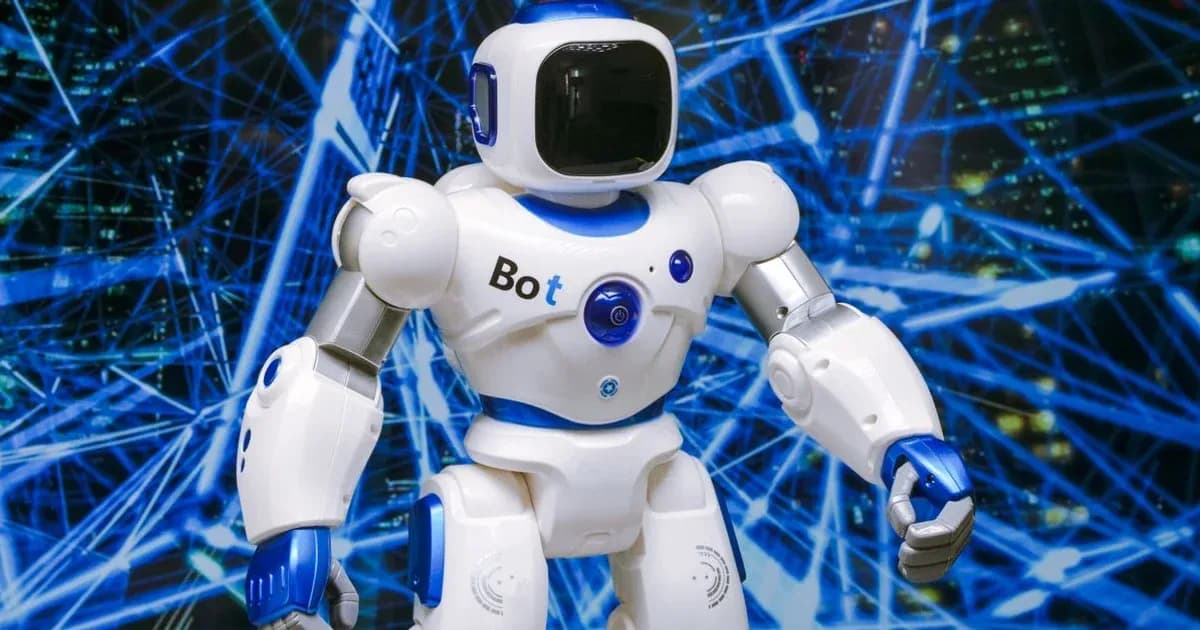
Humanoid Robots Shatter Expectations, Drive Market Validation
The financial markets recently underscored a profound shift: a leading humanoid robot developer, Unitree Robotics, completed an IPO that valued the company north of $10 billion. This market validation arrived concurrently with demonstrations that defy prior expectations for robotic dexterity and speed. Consider the recent 'Robo-Olympics' event: a humanoid platform, Atlas by Boston Dynamics, completed an obstacle course designed for human special operations personnel 30% faster than the average human time. This involved complex maneuvers like vaulting barriers and navigating unstable terrain. [Source: *Boston Dynamics Engineering Blog, July 2026*]. Separately, Figure AI's Figure 01 robot demonstrated continuous heavy lifting, moving 500kg of material in under 15 minutes, a task previously requiring multiple human operators or specialized industrial equipment. This performance showcased not just strength, but sustained operational endurance under load. [Source: *Figure AI Press Release, June 2026*]. These are not laboratory curiosities confined to research grants. These are measurable, repeatable performances that challenge the long-held boundaries of what autonomous systems can achieve physically within dynamic, unstructured environments. The investment community’s response confirms a belief: these capabilities will translate into tangible industrial value rapidly.
The Convergence of AI and Embodied Mechanics
This rapid progression stems from a confluence of engineering and algorithmic breakthroughs, marking a distinct departure from earlier robotic paradigms. At its core, mature reinforcement learning (RL) models provide robots with the capacity to learn complex motor skills from vast simulated data sets, then transfer that knowledge to the physical world with minimal fine-tuning. Previously, engineers painstakingly programmed each motion for specific tasks. Now, algorithms explore millions of permutations of gait patterns, manipulation sequences, and balancing acts, discovering optimal solutions that human designers might overlook. This is the essence of embodied AI – intelligence expressed through physical interaction with the world.
Computer vision systems, running on edge hardware, now process high-resolution sensor data from LiDAR, stereo cameras, and force sensors with sub-millisecond latency. This allows for real-time environmental perception, semantic understanding of objects, and dynamic obstacle avoidance, crucial for operating in complex, unpredictable industrial settings. Instead of reacting to a pre-defined map, these robots perceive and adapt to an evolving workspace, identifying tools, recognizing human presence, and adjusting their actions accordingly. This real-time processing capability is augmented by advancements in sensor fusion, where data from multiple modalities is intelligently combined to create a more complete and accurate understanding of the robot's immediate surroundings.
Underpinning this cognitive agility are equally significant mechanical advancements. Lighter, more energy-dense solid-state batteries extend operational cycles, making longer shifts feasible. High-torque, low-inertia actuators allow for rapid, precise movements across multiple degrees of freedom without excessive energy consumption, reducing operational costs. Material science contributes to lighter frames, more durable joints, and compliant end-effectors that enable delicate manipulation. The integration of these elements creates a system where perception informs decision-making, and decision-making directly translates into agile, efficient physical action. Control systems have also evolved, moving from rigid position control to adaptive impedance control, allowing robots to adjust their stiffness and compliance to interact safely and effectively with their environment.
The iterative development cycle has also accelerated dramatically. High-fidelity simulation environments like NVIDIA's Isaac Sim or Google DeepMind’s MuJoCo allow developers to train and test millions of policy iterations without risking physical hardware or human safety. When the robot enters the real world, it already possesses a foundational understanding of physics and interaction dynamics. This loop, from simulation to real-world deployment and back, compresses years of traditional robotics development into months, minimizing the 'reality gap' that historically hampered robot deployment. This approach minimizes cost and accelerates time to market for new capabilities.
The current generation of humanoids, while often purpose-built for specific industrial functions like material handling or inspection, are increasingly exhibiting generalized intelligence. Their ability to perceive, plan, and execute tasks in unstructured environments marks a significant departure from fixed-arm industrial robots. This is not merely automation; it is autonomous action guided by real-time intelligence, capable of learning and adapting on the job.
Implications for Operational Strategy and Workforce Evolution
For operations managers and line-of-business owners, these developments demand a strategic re-evaluation of current automation roadmaps. The immediate implication rests in addressing persistent labor shortages in sectors like manufacturing, logistics, and retail. Humanoid robots can perform repetitive, ergonomically challenging, or hazardous tasks, freeing human employees for higher-value activities that require nuanced judgment or creative problem-solving. A 2025 Deloitte report estimated that adopting humanoid assistants could reduce injury rates by 40% in manual handling roles, alongside a 25% increase in throughput for specific assembly lines within automotive manufacturing. This directly translates to improved worker safety and heightened productivity.
Deployment no longer means rigid cage systems that separate humans from machines. These new robots are designed for human-robot collaboration, navigating shared spaces safely and interacting intuitively. This changes factory floor layouts, warehouse operations, and even retail environments. Businesses must now consider how to integrate these new 'co-workers' into existing workflows, not just as replacements for human tasks, but as force multipliers that augment human capabilities. This requires new protocols for human-robot interaction, safety training, and clear communication frameworks.
Consider the supply chain. Humanoids can offload pallets from trucks, sort packages on conveyor belts, perform precise order picking in varied inventory configurations, and even manage shelf replenishment in retail. This promises to reduce fulfillment times, improve inventory accuracy, and streamline last-mile delivery tasks in complex urban environments where traditional AGVs (Automated Guided Vehicles) or fixed-arm robots struggle with stairs, doors, or unpredictable pedestrian traffic. In manufacturing, they can execute fine-motor assembly, conduct comprehensive quality checks on components, and perform machine tending with precision and consistency that exceeds human capabilities over long shifts. Our own Shreeng AI Quality Inspection product, for example, already integrates with traditional robotic arms for automated visual inspections, a capability now extending to humanoid platforms for more dynamic, multi-stage processes that require movement between workstations.
The economic impact is substantial. Beyond labor cost reduction, enterprises can achieve significant gains in operational consistency, reduction in waste due to errors, and the ability to scale operations rapidly in response to market demand. However, the challenge for organizations lies in managing the transition effectively. It requires investment not just in the hardware, but crucially, in the AI orchestration layers that enable these robots to learn, adapt, and communicate effectively within a broader operational intelligence framework. Data governance, AI ethics, and proactive workforce reskilling programs become paramount. Ignoring this shift risks ceding competitive advantage to early adopters who embrace this wave of autonomous physical agents with strategic foresight. A 2026 McKinsey Global Institute report projects that industrial humanoid robot deployments could contribute an additional 1.5% to global GDP by 2035 through productivity gains, but only with proper integration.
Shreeng AI’s Position: Orchestrating the Autonomous Workforce
Shreeng AI holds that the current acceleration in humanoid robot capabilities signifies more than an incremental improvement in automation; it marks a definitional shift in how enterprises will execute physical tasks. The era of context-aware, adaptable physical AI agents is here. This means a move from simple automation scripts to truly autonomous, learning systems.
Our perspective is clear: deploying these systems successfully requires a comprehensive AI strategy, not merely purchasing units or integrating them as isolated tools. This strategy begins with `automation-ai`, ensuring humanoid robots can integrate integrated into existing operational technology (OT) and information technology (IT) ecosystems. This includes connecting with Enterprise Resource Planning (ERP), Manufacturing Execution Systems (MES), and Warehouse Management Systems (WMS) to ensure data flows are bidirectional and real-time. It extends to the deployment of `enterprise-ai-agents`—our autonomous AI agents—which can orchestrate complex tasks, manage entire fleets of humanoids, handle error conditions autonomously, and learn from real-time operational data across the entire enterprise. These agents provide the cognitive layer that transforms a complex machine into an intelligent, adaptive contributor, moving beyond simple task execution to actual problem-solving.
Shreeng AI's framework for integrating humanoid agents focuses on three pillars: first, real-time contextual awareness through `ai-video-intelligence` and sensor fusion, enabling robots to interpret their environment with human-like understanding; second, dynamic task allocation and workflow optimization via `decision-intelligence`, allowing for intelligent task assignment and route planning across a mixed human-robot workforce; and third, continuous learning and adaptation through embedded machine learning pipelines, ensuring robots improve over time without constant human intervention. We believe the true value emerges not just from a robot's physical ability, but from its capacity to operate intelligently within an enterprise's unique operational context, leveraging all available data.
Organizations must move beyond isolated pilot programs and initiate comprehensive strategic planning for physical AI integration. This involves identifying high-impact use cases, building scalable AI infrastructure, and establishing clear metrics for ROI, safety, and ethical compliance. The market frenzy around humanoid robots is justified by their technical achievements, but only if enterprises approach deployment with analytical rigor and a clear vision for integrated AI. This is a transformation demanding strategic foresight, not merely technological adoption. Request Executive Briefing to understand how Shreeng AI can guide your organization through this pivotal transition.
Sources
- Boston Dynamics Engineering Blog, July 2026
- Figure AI Press Release, June 2026
- 2025 Deloitte report on manufacturing human-robot collaboration: https://www2.deloitte.com/us/en/insights/topics/manufacturing/manufacturing-human-robot-collaboration.html
- 2026 McKinsey Global Institute report on humanoid robots: https://www.mckinsey.com/capabilities/quantumblack/our-insights/the-next-frontier-of-automation-humanoid-robots
Neha Gupta
Principal ML Engineer
Engineers ML pipelines from training to production — model optimization, serving infrastructure, and monitoring.