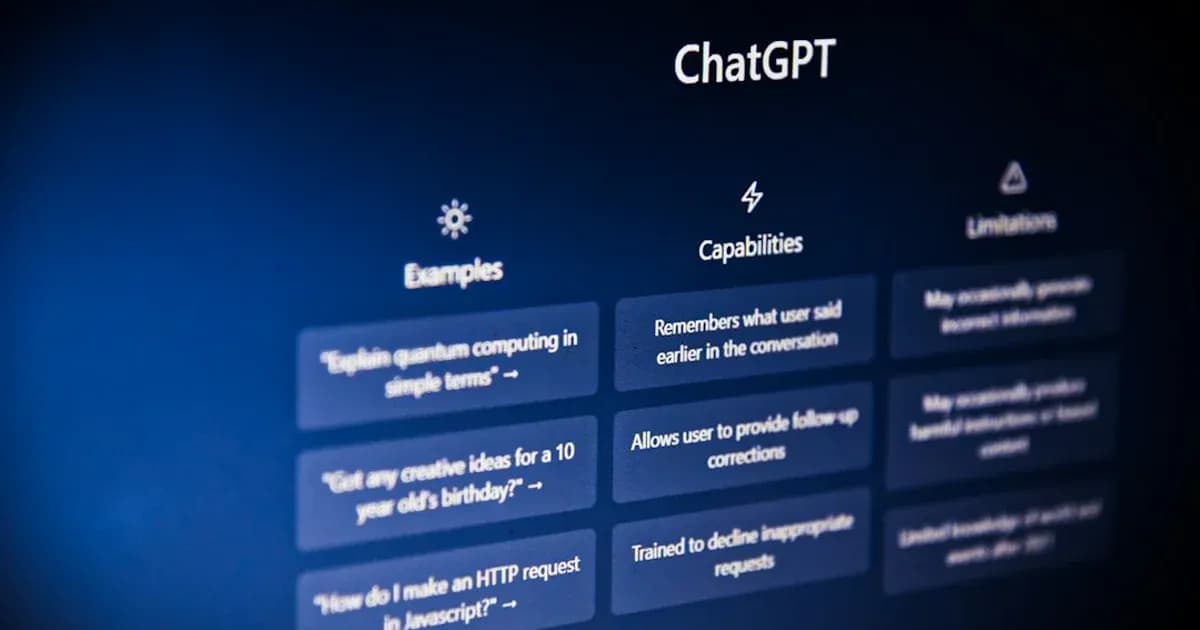
The Shift to Interactive AI
OpenAI's GPT-6 rollout introduces "Intelligent UI" capabilities, moving beyond text-only interactions to generate dynamic, interactive interface elements directly within its responses. This means an AI can now present a button to approve a transaction, a dropdown to filter data, or a chart to visualize trends, all within the conversational context. This represents a significant departure from previous generations, which primarily returned natural language.
The underlying shift stems from advancements in multimodal model architectures. GPT-6 interprets user intent not just semantically but also structurally, predicting the most effective UI component to enable the next step in a workflow. Previous large language models (LLMs) required external frameworks or developers to translate conversational intent into graphical actions. Now, the model itself proposes and renders these interactions.
This capability suggests a deeper understanding of task completion and user interaction design baked into the model's core. Shattered. Io notes that this direct UI generation reduces latency in decision cycles, as users no longer need to parse lengthy text descriptions. This is not merely suggesting a UI; it is generating an interactive element.
Technically, this involves integrating UI component libraries and rendering engines directly into the model's output layer or through a tightly coupled API. The model learns to map specific intents, like "show sales data" or "confirm order," to corresponding UI elements, such as a bar chart or a confirmation dialog. The architecture likely involves a hierarchical generation process. The LLM first determines the high-level intent, then a UI sub-model selects or constructs the appropriate component, populating it with data retrieved by the LLM from connected systems.
Operationalizing Intelligent Interfaces
For organizations, Intelligent UI translates into immediate improvements in workflow efficiency and user adoption of AI tools. Operations managers, often frustrated by the abstract nature of text-based AI interactions, gain concrete, actionable interfaces. Instead of typing "What is the status of order #12345 and can I approve it?", a user might ask, and the AI responds with "Order #12345 status: Pending Approval" alongside an "Approve" button and a "Reject" button. This direct interaction mitigates the "AI black box" perception. Users see tangible actions, not just textual descriptions.
Gizmodo. Com states that this approach significantly lowers the cognitive load on the user. Consider a supply chain manager querying inventory. Instead of a text list, the AI could present an interactive dashboard showing stock levels, supplier lead times, and reorder points, complete with clickable filters. This reduces the need for context switching between conversational AI and separate analytical tools.
And the development cycle for AI-powered applications also shortens. Line-of-business owners can define desired outcomes, and the AI itself can suggest or even generate the necessary interface elements, requiring less specialized UI/UX development. This accelerates time-to-value for new AI initiatives across the enterprise. AIWeekly. Co highlights that this capability democratizes application creation, moving it closer to business users.
Enterprise Agent Automation
The integration of Intelligent UI with autonomous agents marks a new era for enterprise automation. An enterprise-ai-agents solution can now interact with human users through generated UIs, presenting options for decision points or requesting clarification with specific forms. This extends the capabilities of agents beyond mere backend process execution.
For example, an AI agent managing HR onboarding could present a new hire with an interactive form to confirm personal details, directly updating the HR system upon submission. Or, an AI Chatbot on a customer service portal could dynamically generate a product selector interface based on a customer's initial query, simplifying the browsing experience. This convergence of conversational intelligence and UI generation is critical for complex workflows. It allows agents to handle exceptions or incomplete data by proactively requesting specific input via a generated interface, rather than engaging in lengthy, potentially ambiguous text conversations. Shreeng AI's AI Agents product demonstrates how such interfaces can streamline complex operational tasks.
Challenges and Governance
While the promise is clear, the implementation of GPT-6 Intelligent UI in enterprise environments presents specific challenges. Data privacy and security remain paramount. Generated UIs must adhere to strict access controls and data handling protocols. A finance AI presenting a ledger report must ensure only authorized personnel can view sensitive figures.
And the generated interfaces must be consistent with corporate branding and accessibility standards. This requires careful integration and validation, ensuring the AI's output aligns with established design systems. The issue of "hallucination" extends to UI generation. An AI might generate a button that leads nowhere, or a form that requests irrelevant information. This necessitates resilient validation layers and human-in-the-loop oversight, especially for critical applications. Scalability is another concern. Enterprise systems require low latency and high throughput. Generating intricate UIs on demand for millions of users necessitates a highly optimized infrastructure.
Shreeng AI's Stance: Structured Intelligence for Action
Shreeng AI recognizes the transformative potential of Intelligent UI. Our institutional conviction is that true enterprise value from AI emerges when intelligence is actionable, verifiable, and integrated into existing operational frameworks. The ability of GPT-6 to manifest conversational output into interactive elements aligns directly with our mission to deliver decision-intelligence.
We view Intelligent UI not as a replacement for structured application development, but as an acceleration layer. It allows for rapid prototyping and dynamic adaptation of user interactions, particularly in scenarios where user needs are varied or evolving. Our conversational-ai solutions, which span voice, chat, and messaging channels, are evolving to incorporate these dynamic UI capabilities. Imagine a WhatsApp AI Commerce Bot that, instead of just describing product options, presents a scrollable carousel of images with "Add to Cart" buttons directly within the chat interface. This changes the interaction paradigm for commerce.
Shreeng AI's approach emphasizes the need for a control plane over generative capabilities. While GPT-6 can generate UIs, enterprises require governance, audit trails, and data integration. Our AI Agents product, for example, orchestrates workflows using both conversational and structured interfaces, ensuring that generated actions are executed within defined business rules and security parameters. This includes mechanisms for pre-approving UI templates or validating generated components against a schema. The future involves composite AI systems where models like GPT-6 handle the UI generation layer, but a specialized decision-intelligence engine provides the underlying logic, data retrieval, and causal reasoning. This ensures accuracy and adherence to business objectives, moving beyond mere statistical correlation.
We anticipate a future where AI-generated UIs become standard for many internal tools and customer-facing portals. This will democratize access to complex data and workflows, allowing non-technical users to configure and interact with AI systems in ways previously limited to developers. But this future demands a commitment to explainability, auditability, and responsible deployment. The mere presence of an interactive element does not guarantee correct or ethical action. It requires a deliberate, structured approach to AI implementation.
Sources
- aiweekly.co: https://vertexaisearch.cloud.google.com/grounding-api-redirect/AUZIYQGz0aLPwErzQjVQzLy4Y_vcohK4eL2HLOXNzWcBK6ro0QsNmQ4KQyIaKgRutYqCW1iMSHqqmsOWmTRQ5pHG5__eo8cBkgbpaUdySS43BDxC
- shattered.io: https://vertexaisearch.cloud.google.com/grounding-api-redirect/AUZIYQGTJWRbGqnlA07p_MZq9oiE2hZEO7TtAaMuopcfhDaaho_B4xf8cjPCo3E3_VlnASlXwyvYk54WYWOIb-TcwdRgTGyspZDevy2nXUByVAyXyeCQmE1GKU5ROEvGNd2pedavsUTTIoF-UNcZXM3E-MRy9rJ9cUuKOi2qHg==
- gizmodo.com: https://vertexaisearch.cloud.google.com/grounding-api-redirect/AUZIYQE40Gjsfd_sNX8ryAx-AJ5pEFbxK94ZyHh3FjlUclYXSZNZ7WRn6XJmLzerQWO3op3hz1NmFv0zVzcWaAXckbdGKi0huxAVZah_3sJPPLpbGeUUEb9SD7iBlMLjlYqDrkXWp70hNrLfXRyyNKEzSEoaWeVQwIVIpCGMYONhF0fJEpw6D5PhsTud0W0g=
Vikram Nair
VP of Engineering
Oversees platform engineering, infrastructure reliability, and production AI systems across all deployments.