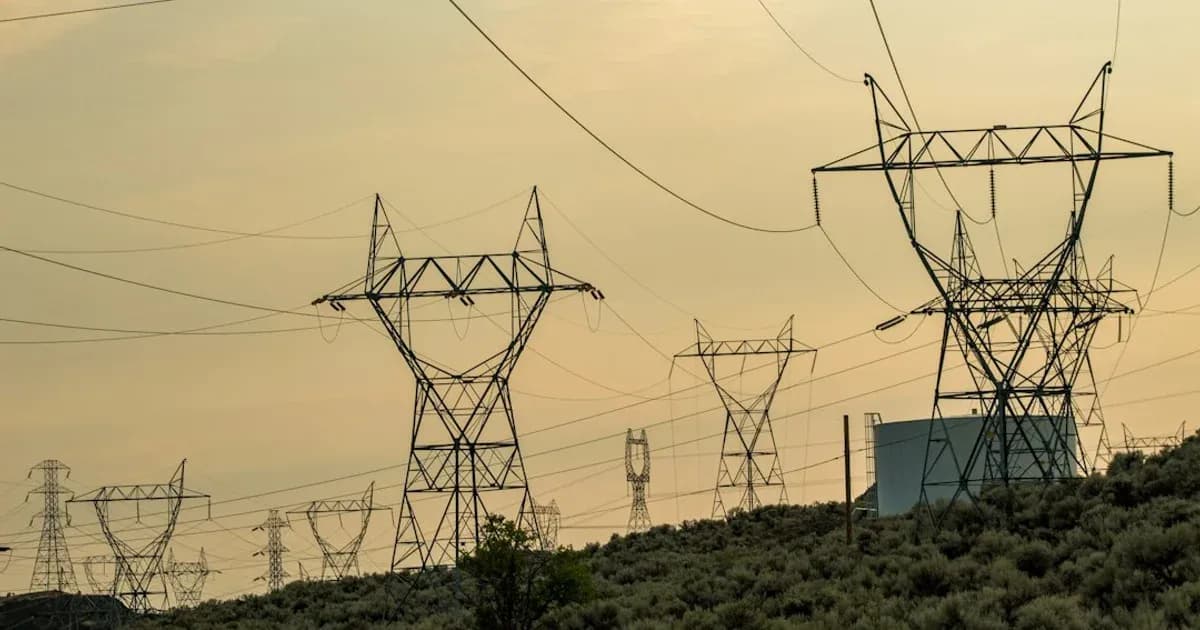
Observation: The Unseen Energy Bill of AI
The immediate focus in AI deployment often centers on chip supply and model sophistication. But a more foundational challenge is emerging: the physical availability of electrical power. Recent reports indicate a dramatic surge in electricity consumption by data centers. Google, for instance, reported a 47% increase in electricity use between 2019 and 2021, a trend accelerating with the proliferation of generative AI. Projections from the International Energy Agency (IEA) suggest that global data center electricity consumption could double from 2022 levels by 2026, reaching over 1,000 TWh. This rare demand places immense pressure on existing power grids and infrastructure, which were not designed for such concentrated, rapid growth. As aninews. In reported in late 2023, the energy needs of AI are escalating rapidly, particularly for training large models, creating a substantial environmental footprint.
The Core of the Problem: Compute Density and Persistent Load
This burgeoning energy requirement stems from the fundamental nature of contemporary AI, specifically deep learning. Training large language models (LLMs) or complex computer vision models demands vast computational resources, often running for weeks or months on thousands of Graphics Processing Units (GPUs). This process consumes gigawatt-hours (GWh) of electricity. For example, training OpenAI's GPT-3 consumed an estimated 1,287 MWh, equivalent to the lifetime carbon emissions of several cars, as detailed in a study by Patterson et al. (2021). These are not transient loads; they represent a persistent, high-density demand.
But the issue extends beyond training. Once deployed, these models perform inference. Every query to an LLM, every image processed by a vision system, every transaction analyzed by a fraud detection algorithm consumes electricity. As enterprises scale their AI deployments, the aggregate inference load becomes substantial. This continuous operational demand strains both internal data center capacity and the external grid.
Analysis: Why the Grid is Struggling to Keep Pace
The underlying systems that produce this outcome are multi-faceted, encompassing both the physics of computation and the economics of infrastructure.
The Physics of AI Compute
Modern AI workloads, particularly those involving neural networks, translate directly into vast numbers of floating-point operations per second (FLOPS). GPUs, while efficient for parallel processing, are energy-intensive components. A single NVIDIA H100 GPU can draw up to 700 watts. A server rack filled with these GPUs, combined with their associated memory, storage, and networking components, can easily exceed 30-50 kW. Multiply this by hundreds or thousands of racks in a hyperscale data center, and the power requirements become astronomical. And, every watt of electricity consumed by compute hardware generates heat, necessitating elaborate and equally energy-intensive cooling systems. The Power Usage Effectiveness (PUE) metric, which measures total facility energy divided by IT equipment energy, rarely reaches the theoretical ideal of 1.0. Even an efficient data center with a PUE of 1.2 means 20% of all energy goes to non-compute functions like cooling and power delivery.
Data Center Infrastructure Limitations
Building a new data center, or expanding an existing one, is a multi-year endeavor. Land acquisition, permitting, construction, and equipment procurement are time-consuming. Securing a connection to the electrical grid with sufficient capacity is often the longest pole in the tent. Utilities must upgrade substations, lay new transmission lines, and ensure their generation capacity can meet the demand. This process can take three to five years, often longer, far exceeding the typical six-to-eighteen-month AI project lifecycle. And it is not just about raw power; it is about reliable, clean power, often requiring redundant feeds and battery backup systems, adding further complexity and cost.
And, data center location is critical. Proximity to major fiber optic networks is non-negotiable for low-latency AI applications. But now, proximity to sufficient and affordable power is becoming an equal, if not greater, determinant. This limits available sites, driving up real estate costs and exacerbating the competition for suitable locations. Many regions, particularly in Europe and North America, are experiencing moratoriums on new data center connections due to grid saturation, according to analysis by Bloomberg.
Grid Capacity and Renewable Integration
The existing electrical grid in many nations, including India, was designed for distributed loads and predictable demand patterns. The sudden emergence of “AI factories” – massive, concentrated loads that operate 24/7 – presents a unique challenge. Upgrading the grid requires significant capital investment and political will. Integrating renewable energy sources, while a long-term goal for many data center operators, also adds complexity. Connecting a new solar farm or wind installation to the grid, ensuring stability, and providing baseload power when renewables are not generating, takes time and substantial investment. This delay in green energy deployment means many new data centers still rely heavily on fossil fuel sources, further compounding environmental concerns.
Implication: A Divided Future for Enterprise AI
This evolving power constraint carries profound implications for organizations operating in the AI space. It will redefine the competitive landscape and the strategic decisions facing chief technology officers (CTOs) and chief information officers (CIOs).
The Enterprise Bottleneck and Competitive Divide
The most immediate implication is a significant bottleneck for enterprise AI deployments. Access to sufficient power will become a primary gating factor, potentially overshadowing concerns about talent, data, or even specialized hardware. Companies seeking to scale their AI initiatives, whether for internal automation or customer-facing services, will find themselves competing for a finite and increasingly expensive resource.
This inevitably creates a competitive divide. Hyperscale cloud providers – Google, Amazon, Microsoft – are investing billions in their own power generation and grid connections, often signing direct power purchase agreements with renewable energy providers or even building their own nuclear micro-reactors. They possess the capital and long-term planning horizons to secure these resources. Enterprises without such scale or resources will struggle to replicate this infrastructure. This means that while AI promises democratization, its fundamental infrastructure requirements could centralize its most compute-intensive applications within the confines of a few large technology companies. For most organizations, deploying a custom LLM from scratch on their own infrastructure may become economically and logistically unfeasible.
Strategic Re-evaluation for CTOs and CIOs
CTOs and CIOs must re-evaluate their AI strategy through the lens of power availability. The traditional debate of on-premise versus cloud deployment will gain a new dimension. While cloud offers flexibility, reliance on hyperscalers means relinquishing direct control over the underlying power economics. On-premise deployments, while offering data sovereignty and potentially lower long-term operational costs, now face the daunting challenge of securing adequate power supply for future expansion. This mandates a shift towards a more distributed compute strategy.
One critical avenue is the strategic adoption of **edge AI**. Moving inference workloads closer to the data source – on factory floors, in retail stores, or within smart city infrastructure – reduces the burden on central data centers. This localized processing minimizes data transfer latency and, crucially, shifts power consumption to areas where it might be more readily available or manageable. For example, deploying object detection models on local cameras in a manufacturing plant for quality inspection, rather than streaming all video to a central cloud, significantly reduces overall energy footprint.
Another imperative is **model optimization**. The era of merely training larger and larger models without regard for efficiency is unsustainable. Techniques like model quantization, pruning, knowledge distillation, and efficient model architectures (e. G., MobileNet, TinyBERT) are no longer academic exercises; they are essential for practical, scalable deployment. CTOs must demand that their data science teams prioritize model efficiency from the outset of any project. This will enable organizations to achieve meaningful AI outcomes with a fraction of the compute and therefore, power, required by unoptimized models.
Position: Shreeng AI's Mandate for Efficient Intelligence
Shreeng AI holds that the future of enterprise AI hinges on intelligent resource management, not merely on raw compute capacity. The current trajectory of ever-increasing model size and centralized compute is strategically unsound for most organizations and environmentally irresponsible. Our conviction is that computational efficiency must be a core design principle for any responsible AI deployment.
We advocate for a structural change towards **distributed intelligence** and **optimized execution**. Relying solely on larger models and centralized hyperscale infrastructure for every AI task is unsustainable and strategically unsound for most enterprises. Instead, organizations must embrace a tiered approach, deploying compute where it makes the most sense from a power, latency, and security perspective.
Shreeng AI's solutions are engineered to address these challenges directly. Our enterprise-ai-agents are designed for specific, outcome-driven workflows, ensuring that compute resources are applied precisely where needed, avoiding wasteful over-provisioning. These agents, exemplified by our AI Agents product, execute tasks with minimal overhead, allowing enterprises to automate complex processes without necessitating a new data center build-out.
And, our approach to industry-ai focuses on deploying intelligence at the edge. For example, our Predictive Maintenance platform utilizes lean, optimized models for anomaly detection and forecasting directly on industrial machinery. This edge processing minimizes data egress to central clouds and reduces the overall energy footprint of operational intelligence. Instead of sending terabytes of sensor data to a distant data center for analysis, the intelligence resides locally, reacting instantly and consuming only the power necessary for real-time insights.
We champion research and development into more energy-efficient algorithms and hardware-aware AI design. This includes exploring neuromorphic computing and other non-conventional architectures that promise lower power consumption per operation. For enterprises, this means strategic planning for AI deployments that consider total cost of ownership, including the rapidly escalating cost and scarcity of electricity. Shreeng AI assists organizations in designing AI architectures that are not only effective but also sustainable and scalable within real-world power constraints. The era of limitless compute is over. The era of intelligent, efficient compute has begun. Organizations that adapt now will secure their competitive advantage. Those that do not will find their AI ambitions curtailed by the grid's limitations.
Sources
- https://vertexaisearch.cloud.google.com/grounding-api-redirect/AUZIYQG4NbgsY_jMdk3iqbkUvna4M5k3V-LR91Msi5l2tTEL5aZHU6OaBlx_ARhFMvpvdEQe8H4DC_HL8fF4xdqYw4kACGoLfIDOclvQWGMPJ46fxzZ94zgtNxZFwI0iAzzLAqtGvBS-aPHlym6nW2fY9ZuO_ZkflHE-vF-IFnwEOHyp5oTY5yCFAfASZJc8L3lSuXBg7awPbUAQbC4ybhKSS_Ywem_S_urUqGBNJbr94_QAaPBsHEnQz0g12Qe7Du7apkrcbBgvFHhIkdM=
- https://arxiv.org/abs/2104.10350
- https://www.iea.org/reports/data-centres-and-telecommunication-networks
- https://www.bloomberg.com/news/articles/2023-10-18/data-centers-are-straining-electric-grids-to-the-limit-around-the-world
Vikram Nair
VP of Engineering
Oversees platform engineering, infrastructure reliability, and production AI systems across all deployments.