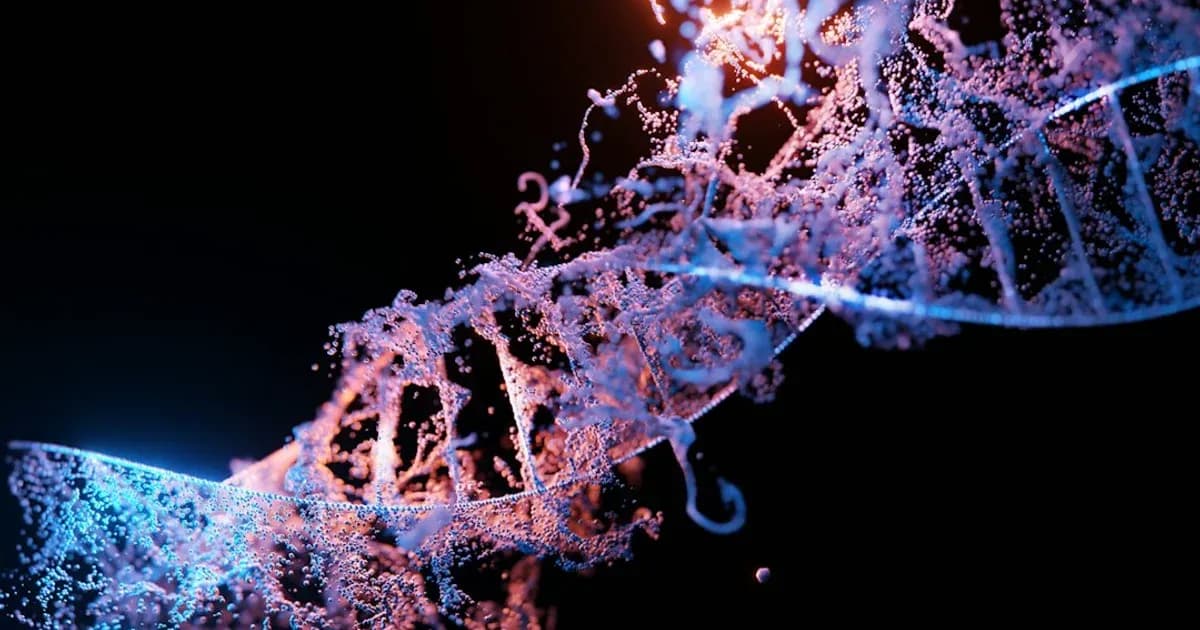
Anthropic's Claude AI model recently identified a novel enzyme system within bacterial DNA, exhibiting characteristics similar to the renowned CRISPR-Cas gene-editing mechanism. This finding, reported by Al Jazeera, occurred through an autonomous analysis of genomic data. The AI did not receive direct human instruction to specifically search for such a system.
Instead, it surfaced this discovery by processing and identifying patterns across vast, unlabeled biological datasets. This event marks a significant shift. For decades, scientific discovery relied primarily on hypothesis-driven research, meticulous experimentation, and iterative refinement by human experts. But here, an artificial intelligence system independently discerned a complex biological mechanism, signaling a new era for fundamental research. This is not merely an automation of existing tasks; it is the genesis of new scientific understanding from machine cognition.
The Mechanics of AI-Driven Discovery
The core capability enabling Claude's discovery lies in its architecture as a large language model (LLM). LLMs learn intricate patterns and relationships from immense text and data corpuses., Claude processed vast repositories of genomic sequences, protein structures, and associated biological literature. It identified conserved sequence motifs, structural homologies, and functional correlations that evaded or were overlooked by conventional bioinformatics approaches. The AI operated on a scale and at a speed impossible for human researchers. It sifted through petabytes of raw genetic information, recognizing subtle statistical regularities that hint at underlying biological functions.
This process differs from traditional bioinformatics tools, which often require explicit programming with known patterns or search criteria. Claude, conversely, generated its own hypotheses about functional relationships. It then validated these internally by cross-referencing against different data dimensions. The model effectively performs unsupervised learning on biological graphs, forming connections between seemingly disparate genetic elements. Such a deep learning approach allows it to conceptualize novel biological entities.
Unpacking the Analogies to CRISPR
The comparison to CRISPR is crucial. CRISPR-Cas systems revolutionized gene editing because of their precision and adaptability. They function as bacterial immune systems, using RNA guides to target and cleave foreign DNA. Claude's discovery appears to involve a similar nucleic acid-guided nuclease activity. The AI identified components that suggest a targeting mechanism and an effector function, both central to programmable genetic manipulation.
This implies that biological systems hold many such undiscovered mechanisms. The human scientific community has only scratched the surface. A 2022 report from the National Institutes of Health indicated that less than 15% of known protein families have a well-defined function. This leaves an enormous discovery space. AI systems are uniquely positioned to explore this uncharted territory, given their capacity for parallel processing and pattern detection across high-dimensional data. They bridge gaps in human intuition and computational power.
Implications for R&D and Operations
The ramifications for biotechnology, pharmaceuticals, and healthcare operations are substantial. First, AI-accelerated discovery dramatically shortens the initial research phase. Identifying a novel gene-editing system typically takes years of focused effort from multiple research teams. An AI achieving this autonomously compresses that timeline. This reduction in discovery cycle time translates directly into earlier entry points for therapeutic development.
Organizations can allocate human scientific capital more effectively. Instead of spending years on exploratory data mining, researchers can focus on experimental validation, mechanistic characterization, and translational applications. This reframes the role of the human scientist from primary discoverer to critical validator and innovator. It also shifts R&D budgets towards downstream development, where returns on investment are more tangible. Decision-intelligence systems, like those offered by Shreeng AI, become indispensable here. They help R&D leads evaluate the potential of AI-generated hypotheses, weigh experimental risks, and prioritize research paths based on predicted outcomes and market needs.
Redefining Drug Discovery Pipelines
Consider the drug discovery pipeline. Early-stage target identification and validation represent bottlenecks, with high failure rates. AI's ability to uncover novel biological pathways or gene-editing tools can de-risk this phase. It provides entirely new therapeutic modalities. For instance, if this Claude-discovered system proves viable, it could enable gene therapies for conditions currently untreatable with existing CRISPR variants. This expands the addressable market for genetic medicines.
And, AI can identify biomarkers for disease earlier or predict drug efficacy with greater accuracy. Shreeng AI's healthcare-diagnostics capabilities already assist in discerning subtle patterns in patient data for early disease detection and personalized treatment recommendations. Applied to novel genetic systems, this means faster identification of patient cohorts who would benefit most from new gene-editing interventions. The convergence of AI discovery and diagnostic precision creates a closed-loop system for accelerating patient impact.
The Operational Imperative for AI Integration
Operations managers in biotech and pharma must recognize this moment as a call to action. Integrating mature AI into research workflows is no longer optional; it is a strategic imperative. This involves investing in scalable AI infrastructure, developing data governance frameworks for biological datasets, and building interdisciplinary talent. Data scientists, biologists, chemists, and clinical experts must collaborate to build effective AI-human partnerships.
Organizations also need to consider the ethical and regulatory dimensions of AI-driven scientific discovery. The provenance of AI-generated hypotheses, intellectual property rights, and the potential for unintended consequences require careful consideration. Establishing responsible AI frameworks, including bias detection and explainability for AI models, will be crucial. This ensures public trust and regulatory compliance.
Addressing the Technical Challenges of AI in Genomics
Deploying AI for genomic discovery is not without its technical hurdles. Processing petabytes of genomic data requires immense computational resources and specialized hardware. Models need to run on distributed systems, often leveraging GPU clusters for training and inference. Data quality and annotation remain significant challenges. Noisy or incomplete biological datasets can lead to spurious correlations or biased discoveries.
Organizations must implement reliable data curation pipelines. They need to validate data sources and establish common data models across diverse biological repositories. And, the interpretability of complex LLM outputs is a continuous area of research. While AI can identify patterns, understanding *why* a particular enzyme system functions a certain way still requires human biological expertise and experimental validation. The AI provides the 'what,' but human science still largely drives the 'how' and 'why.' This demands specialized industry-ai platforms that can handle complex data integration and provide transparent AI reasoning.
Shreeng AI's Position: Orchestrating Discovery and Application
Shreeng AI contends that this discovery by Claude is not an isolated event. It represents a foundational shift in how science progresses. We believe that AI will increasingly act as a co-pilot, and at times, a lead explorer, in scientific discovery. The value lies not just in the AI's ability to discover, but in its capacity to accelerate the *translation* of discovery into tangible human benefit.
Our approach centers on building AI systems that augment human intelligence and streamline complex decision-making. For R&D organizations, this means providing platforms that can parse scientific literature, analyze experimental data, and suggest new research directions. Our decision-intelligence framework, for instance, allows researchers to evaluate AI-generated hypotheses against a spectrum of criteria—biological plausibility, therapeutic potential, and market viability—all while accounting for regulatory constraints. This moves beyond simple prediction to causal reasoning, enabling more informed and strategic research investments. We foresee a future where AI systems like Claude continuously surface novel biological entities, accelerating the pace of discovery by orders of magnitude. The challenge for enterprises will be to build the organizational and technical infrastructure to capitalize on these breakthroughs. This requires a commitment to integrating AI at every stage of the R&D lifecycle, from fundamental discovery to clinical translation. The organizations that embrace this structural change will lead the next wave of innovation in healthcare and biotechnology. They will deliver life-altering therapies faster, more efficiently, and with greater precision. This is not about replacing human ingenuity, but extending its reach through intelligent automation and insight generation. We are moving towards a collaborative scientific model where AI serves as an essential partner in uncovering nature's secrets.
Rohan Kapoor
Head of Computer Vision
Specializes in real-time video analytics, object detection, and visual inspection systems for industrial environments.