Electricity grids operate on a deceptively simple principle: generation must equal consumption at every instant. Any imbalance — surplus or deficit — manifests as frequency deviation. Small deviations are managed by automatic generation control. Large deviations cause equipment damage, cascading failures, and blackouts. Grid operators have maintained this balance for a century using dispatchable generation: fossil fuel plants that increase or decrease output on command, responding to demand fluctuations in real time.
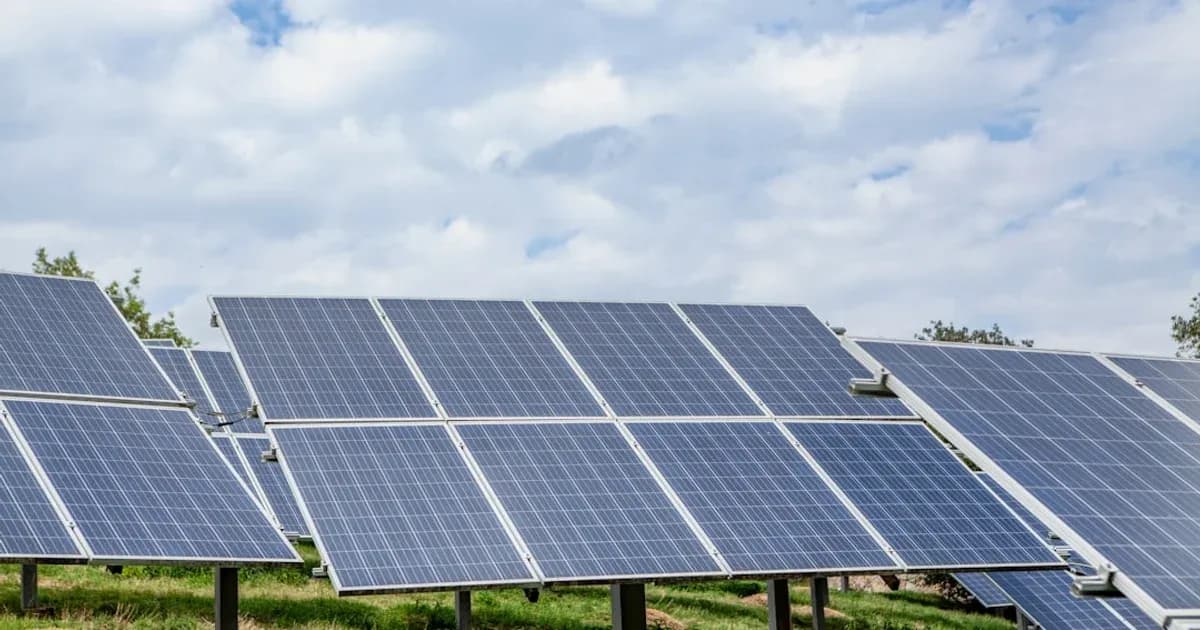
Renewable energy disrupts this operational model. Solar generation depends on cloud cover. Wind generation depends on atmospheric conditions. Neither is dispatchable — grid operators cannot command the sun to shine brighter or the wind to blow harder when demand peaks. India's commitment to 500 GW of non-fossil fuel capacity by 2030 — up from approximately 190 GW installed through 2025 — means the grid will increasingly depend on generation sources that the operator cannot control. Managing this transition without compromising reliability is among the most consequential engineering challenges India faces.
AI addresses this challenge through three capabilities: forecasting generation and demand with sufficient accuracy to plan ahead, optimising the dispatch of flexible resources (storage, demand response, gas turbines) to fill gaps, and detecting grid anomalies before they cascade into failures. None of these capabilities is optional. All three must operate simultaneously, in real time, across a grid that spans 3.28 million circuit kilometres.
Generation Forecasting: Predicting the Unpredictable
Solar and wind generation forecasting has improved substantially over the past decade. Modern AI models achieve 15-minute ahead forecast errors below 5% for solar farms and below 10% for wind farms under typical conditions. These models combine numerical weather predictions, satellite imagery, ground-level sensor data, and historical generation patterns to estimate output for the next hours and days.
The challenge increases with temporal resolution and geographic scope. A national grid operator needs forecasts for thousands of individual solar and wind installations, aggregated to regional and national levels, at 5-minute intervals, for planning horizons from 15 minutes to 72 hours. Each installation has site-specific characteristics — panel orientation, terrain shading, local microclimate effects — that influence generation patterns. Cloud shadows crossing a solar farm create ramp rates (generation changes per minute) that the grid must absorb.
The Predictive Analytics Platform provides the computational architecture for multi-site generation forecasting. The system ingests weather model outputs, satellite cloud cover imagery, and real-time generation data from SCADA systems, producing probabilistic forecasts that quantify both expected generation and uncertainty. This uncertainty quantification is critical: a forecast of 500 MW solar generation with 95% confidence bounds of 450-550 MW allows different operational planning than the same point forecast with bounds of 300-700 MW.
India's State Load Despatch Centres (SLDCs) and the National Load Despatch Centre (NLDC) are progressively integrating AI forecasting into grid operations. The Central Electricity Regulatory Commission (CERC) now requires renewable generators to provide day-ahead and intra-day forecasts, with deviation penalties for generators that deviate significantly from forecasted output. This regulatory framework creates direct financial incentives for forecast accuracy.
Demand Forecasting and the Duck Curve Challenge
Grid demand forecasting has a longer history than generation forecasting, but AI is transforming its accuracy and granularity. Traditional demand forecasting uses historical load patterns adjusted for temperature, day type, and season. AI models incorporate additional signals: industrial production schedules, special events, social behaviour patterns, and — increasingly — the demand-side effects of rooftop solar, electric vehicles, and smart appliances.
India faces a particular version of the "duck curve" — the load shape that occurs when midday solar generation reduces net demand (demand minus solar generation) to a trough, followed by a steep ramp as solar output declines in the evening while demand peaks. This pattern, first observed in California, is emerging in Indian states with high solar penetration. The evening ramp — from approximately 4 PM to 7 PM — requires rapid deployment of generation capacity equivalent to the day's solar output, compressed into a three-hour window.
Managing the duck curve requires accurate forecasting of both the midday trough and the evening ramp. Over-committing generation during the trough wastes fuel and creates curtailment pressure on renewables. Under-preparing for the ramp risks frequency deviations and load shedding during peak demand. AI demand forecasting, combined with solar generation forecasting, enables grid operators to plan the ramp with precision — pre-positioning generation resources, scheduling battery discharge, and activating demand response programmes before the ramp begins.
Storage Optimisation and Demand Response
Energy storage — primarily battery systems, but also pumped hydro and emerging technologies — serves as the grid's buffer between intermittent generation and inflexible demand. The operational challenge is deceptively complex: when to charge, when to discharge, and how much capacity to reserve for contingencies. These decisions depend on forecasted generation and demand, electricity market prices, battery degradation costs, grid stability requirements, and the probability distribution of unexpected events.
AI-based storage optimisation considers all these variables simultaneously. The system determines charge and discharge schedules that maximise economic value while maintaining grid stability requirements. During periods of excess solar generation, storage absorbs surplus energy that would otherwise be curtailed. During evening ramp periods, storage discharges to reduce the demand on fossil fuel generators. During grid contingencies — unexpected generator trips or transmission line faults — storage provides immediate frequency response faster than any conventional generator.
Demand response programmes — where large consumers voluntarily reduce consumption during grid stress in exchange for financial incentives — add another layer of flexibility. AI systems identify which demand response resources to activate, for how long, and in what sequence, based on forecast grid conditions, consumer participation patterns, and contractual constraints. The Industry AI Platform supports the integration of industrial demand response into grid optimisation, enabling large manufacturing facilities to shift energy-intensive processes to periods of high renewable generation.
India's Bureau of Energy Efficiency (BEE) and the Forum of Regulators are developing frameworks for demand response at scale. The Energy Conservation (Amendment) Act 2022 introduced a carbon credit trading scheme and expanded BEE's mandate to cover large residential buildings. As these frameworks mature, the pool of flexible demand resources available to grid operators will expand, increasing the value of AI optimisation algorithms that can coordinate thousands of distributed resources.
Grid Anomaly Detection and Predictive Maintenance
Grid infrastructure — transformers, transmission lines, switchgear, protection systems — deteriorates over time. Component failures cause outages, equipment damage, and in severe cases, cascading failures affecting millions of consumers. Traditional maintenance follows scheduled intervals (time-based) or responds to failures (reactive). Neither is optimal: time-based maintenance replaces components that still have useful life, while reactive maintenance accepts the cost of unplanned outages.
AI-based predictive maintenance analyses sensor data from grid equipment — temperature, vibration, dissolved gas analysis for transformers, partial discharge measurements for switchgear — to estimate remaining useful life and predict impending failures. The system identifies degradation patterns that precede failure, enabling maintenance to be scheduled during planned outages rather than responding to emergency failures.
Smart meter data provides another anomaly detection channel. Voltage irregularities, power factor deviations, and unusual consumption patterns at the distribution level can indicate technical losses (equipment problems), non-technical losses (theft or meter tampering), or safety hazards (faulty wiring). AI analysis of smart meter data at scale — India's Smart Meter National Programme targets 250 million smart meters — enables distribution companies to identify and locate problems that are invisible in aggregated data.
India's [Energy Sector](/industries/energy) Transition
India's energy transition operates under unique constraints. Peak demand continues to grow at 5-7% annually, driven by economic growth, urbanisation, and increasing cooling load (air conditioning penetration is below 10% nationally but growing rapidly). Coal remains the dominant generation source and will continue providing baseload for the foreseeable future, even as renewable capacity expands. The grid infrastructure — transmission lines, substations, distribution networks — requires massive investment to accommodate decentralised renewable generation and bidirectional power flows.
These constraints make AI grid optimisation not an efficiency improvement but a structural necessity. A grid with 500 GW of non-fossil capacity alongside existing thermal generation cannot be operated with traditional tools and manual processes. The volume of data, the speed of required decisions, and the complexity of optimisation across generation, storage, demand, and network constraints exceed human analytical capacity.
The transition also creates opportunities. India's grid modernisation investment — estimated at over $30 billion through 2030 for transmission and distribution — includes digital infrastructure that generates the data AI systems require. Smart meters, phasor measurement units, SCADA upgrades, and communication infrastructure create the sensing and control fabric that enables AI-based grid management.
The power sector has historically been conservative in technology adoption, with good reason: reliability is paramount and the consequences of system failure are severe. AI adoption in grid operations will follow a measured trajectory — starting with forecasting and planning functions where errors are recoverable, progressing to real-time dispatch optimisation as confidence builds, and eventually extending to autonomous grid management for routine operations with human oversight for contingencies. The organisations building these capabilities now — grid operators, system integrators, and technology providers — are positioning for a transformation that will define India's energy infrastructure for decades.
Sources
Neha Gupta
Principal ML Engineer
Engineers ML pipelines from training to production — model optimization, serving infrastructure, and monitoring.