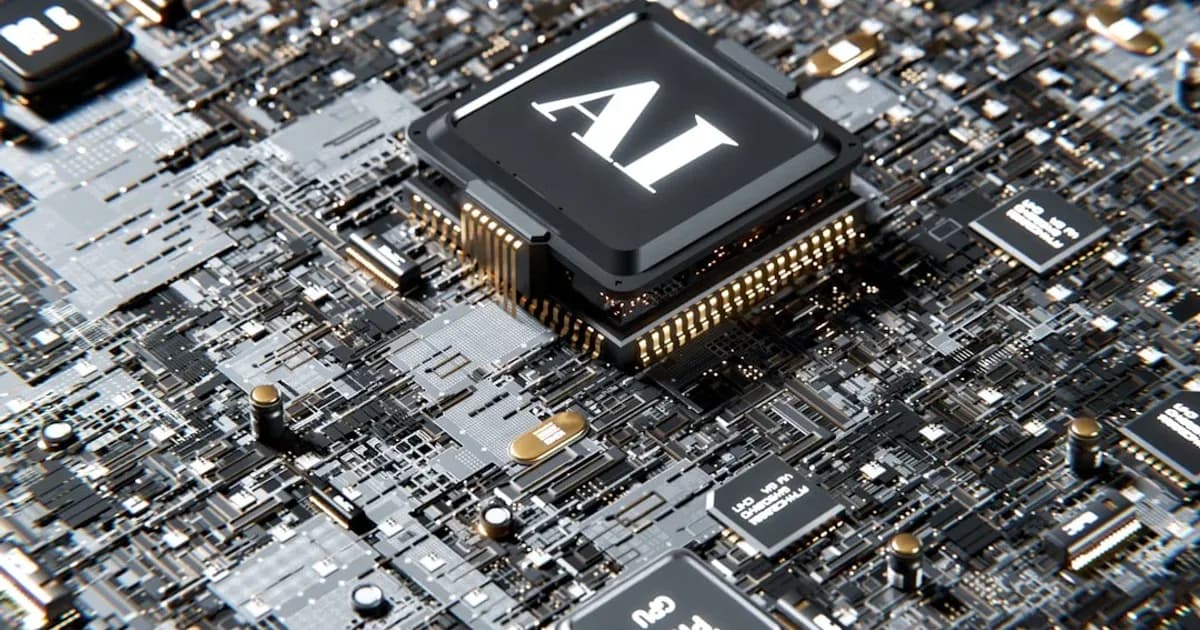
The global technology sector observes a profound shift in the foundational architecture supporting artificial intelligence. This shift manifests as an escalating drive among leading tech entities to engineer proprietary silicon specifically for AI workloads. OpenAI's reported exploration into designing its own AI chips, alongside Google's sustained investment in its Tensor Processing Units (TPUs) now in their fifth generation, signals a reorientation from general-purpose hardware to domain-specific computational units. This movement is not merely an engineering preference; it represents a strategic pivot impacting the entire AI infrastructure landscape. The demand for specialized processing units has grown commensurate with the complexity and scale of contemporary AI models, pushing the limits of conventional hardware.
The Drive for Domain-Specific Compute
The impetus for this custom AI silicon race stems from a fundamental divergence between traditional CPU/GPU architectures and the computational demands of deep learning. General-purpose GPUs, while initially instrumental in accelerating AI development, exhibit limitations in energy efficiency, cost at scale, and latency for specific neural network operations. These limitations become pronounced when training trillion-parameter models or deploying inference at the edge with stringent real-time requirements.
The Inefficiency of General-Purpose Hardware
Deep learning models, particularly large language models (LLMs) and diffusion models, rely heavily on dense matrix multiplications, convolutions, and vector operations. GPUs perform these well, but their design incorporates extensive general-purpose logic and memory management units that are often underutilized during AI tasks. This leads to wasted computational cycles and increased power consumption. For instance, a 2022 study by Stanford University indicated that the energy consumption for training certain large models doubled roughly every six months, making general-purpose hardware economically unsustainable for many organizations.
The Rise of Application-Specific Integrated Circuits (ASICs)
Custom AI silicon, primarily in the form of ASICs, addresses these inefficiencies by optimizing the hardware instruction set and data pathways specifically for AI algorithms. These chips often feature specialized tensor cores or matrix multiplication units (MMUs) designed to execute parallel operations central to neural networks with maximal throughput and minimal energy expenditure. Google's TPUs exemplify this approach, demonstrating significant performance advantages for specific TensorFlow workloads compared to contemporary GPUs. For example, Google reported its TPU v4 chips delivered 2.7 times the performance per watt of GPU equivalents for AI training.
The architectural differences are substantial. Custom chips often integrate high-bandwidth memory (HBM) closer to the processing units, reducing data transfer bottlenecks. They may also employ novel interconnect topologies to enable rapid communication between multiple chips in a large-scale training cluster. This co-design of hardware and software, where the chip's instruction set is tailored to the AI framework's primitives, allows for fine-grained optimization not possible with off-the-shelf components. Microsoft's Maia 100 chip, designed for cloud AI workloads, and Amazon's Trainium and Inferentia chips, for training and inference respectively, further illustrate this trend. These companies are not simply buying faster general-purpose chips; they are engineering specific silicon to meet their unique cloud infrastructure and AI service demands.
Technical Deep Dive: Design and Optimization
Developing custom AI silicon involves intricate engineering across multiple domains. Chip architects decide on the core processing elements – often a blend of configurable data-path units and specialized accelerators. The choice of process technology (e. G., 5nm, 3nm from TSMC or Samsung) directly impacts transistor density and power efficiency. Memory subsystems are critical; integrating HBM stacks or even on-die SRAM provides the necessary bandwidth for large models.
Consider the data flow in a custom AI chip. Input tensors move from memory to a series of processing units, which might include systolic arrays for matrix multiplication. These arrays are highly parallel, enabling thousands of operations to occur concurrently. The output then progresses through activation functions and subsequent layers, with minimal latency. The software stack, including compilers and runtime libraries, must then translate high-level AI frameworks (PyTorch, TensorFlow) into the chip's native instruction set. This necessitates deep integration between hardware and software teams, a challenge for any enterprise attempting to build its own silicon. The potential for open-source hardware architectures, like RISC-V, also presents an alternative pathway for custom designs, allowing more flexibility and avoiding vendor lock-in inherent in proprietary instruction sets.
Implications for Enterprise AI Strategy
For organizations deploying AI at scale, the proliferation of custom AI silicon carries profound implications across strategic, operational, and financial dimensions. The era of a single, dominant hardware architecture for AI is concluding. CTOs and AI engineers face a future defined by diverse compute options, each optimized for particular workloads and cost profiles.
Strategic Resource Allocation and Cost Management
The immediate impact is on resource allocation. Relying solely on general-purpose GPUs may become economically prohibitive for certain large-scale AI operations, particularly training foundation models or running high-volume inference services. Organizations must assess their specific computational needs. Is the priority raw training speed for massive models? Or is it low-latency, energy-efficient inference at the edge? The answer determines the optimal hardware choice. A 2024 Gartner report projects that by 2026, over 80% of enterprises will increase their spending on AI infrastructure, making efficient hardware selection a core strategic imperative.
This demands a granular understanding of AI model architectures and their hardware requirements. Custom silicon can offer superior price-performance ratios for specialized tasks, but it often entails higher initial development costs or a reliance on specific cloud providers. This creates a delicate balance between optimization and potential vendor dependence. Organizations must weigh the long-term total cost of ownership (TCO) against the immediate capital expenditure or cloud service fees.
Operational Complexities and Skill Gaps
Operating environments will grow more heterogeneous. Managing a fleet of diverse AI accelerators – a mix of GPUs, TPUs, and potentially other ASICs – introduces operational complexities. MLOps pipelines must adapt to target different hardware backends, requiring specialized compilers, schedulers, and monitoring tools. This necessitates upskilling engineering teams in hardware-aware software optimization and heterogeneous computing. The talent market for AI infrastructure engineers with expertise in custom silicon is already constrained.
And, the supply chain for these specialized chips remains concentrated. Geopolitical factors and manufacturing capacity limitations can introduce significant risk. Enterprises must consider supply chain resilience when making long-term hardware commitments. For example, a 2023 analysis by Deloitte highlighted the vulnerabilities in the AI chip supply chain due to geographical concentration of foundries.
Impact on AI Model Development and Deployment
The shift to custom silicon influences how AI models are designed and deployed. Model developers may need to consider hardware constraints and capabilities earlier in the design process to maximize performance. This could lead to a proliferation of hardware-specific model optimizations, potentially fragmenting the AI software ecosystem. For enterprises, integrating these optimized models into existing workflows demands flexible AI platforms. Shreeng AI’s `industry-ai` solutions, for example, are engineered to abstract hardware complexities, providing a unified platform for deploying diverse AI models across varied computational environments, from cloud-based custom silicon to edge devices. This approach ensures operational intelligence remains coherent regardless of the underlying hardware.
Shreeng AI's Position: Navigating the Heterogeneous Compute Future
Shreeng AI holds that the escalating competition in custom AI silicon represents a fundamental re-architecture of enterprise AI compute. This is not a transient trend; it is the inevitable outcome of pushing AI model scale and performance beyond the limits of general-purpose hardware. Enterprises that fail to engage with this shift risk substantial competitive disadvantages in efficiency, speed, and cost.
The future of enterprise AI will not be defined by a single, monolithic chip architecture, but by a diverse, heterogeneous compute fabric. Success hinges on the ability to strategically select, deploy, and manage AI workloads across this varied hardware landscape. Generic solutions will struggle to meet the specific performance and cost requirements of mature AI. Organizations must move beyond a hardware-agnostic stance.
Shreeng AI advocates for a hardware-aware AI strategy, one that integrates foundational knowledge of silicon capabilities with the operational realities of enterprise deployment. This means embracing platforms that can intelligently orchestrate workloads across differing compute units, ensuring optimal resource utilization and performance. Our `decision-intelligence` frameworks are specifically designed to assist organizations in making these complex hardware procurement and deployment choices, providing evidence-based recommendations tailored to specific business objectives and AI model characteristics.
And, the operationalization of AI models on specialized hardware requires complex management. Shreeng AI's `ai-agents` product helps automate the deployment, monitoring, and scaling of AI models across varied infrastructure, including those powered by custom silicon. These agents ensure that models, such as those used in our `predictive-maintenance` platform, operate at peak efficiency by intelligently allocating compute resources. This approach allows enterprises to capitalize on the performance gains of custom silicon without incurring undue operational overhead. The strategic imperative is clear: understand the silicon, align it with your AI objectives, and deploy with systems designed for this new compute reality. Request Executive Briefing to explore how Shreeng AI can guide your organization through this evolving landscape.
Sources
- https://hai.stanford.edu/news/ai-index-2022-report-shows-breakthroughs-cost-and-scale-ai-systems
- https://cloud.google.com/blog/products/ai-machine-learning/google-tpu-v4-performance-cost-efficiency
- https://www.gartner.com/en/articles/gartner-predicts-ai-will-become-a-top-investment-priority-for-most-cios-by-2026
- https://www2.deloitte.com/us/en/insights/industry/technology/tech-trends/2023/ai-chip-supply-chain.html
Deepika Rao
Senior Platform Engineer
Builds and maintains the cloud, on-premises, and edge deployment infrastructure that runs Shreeng AI platforms.