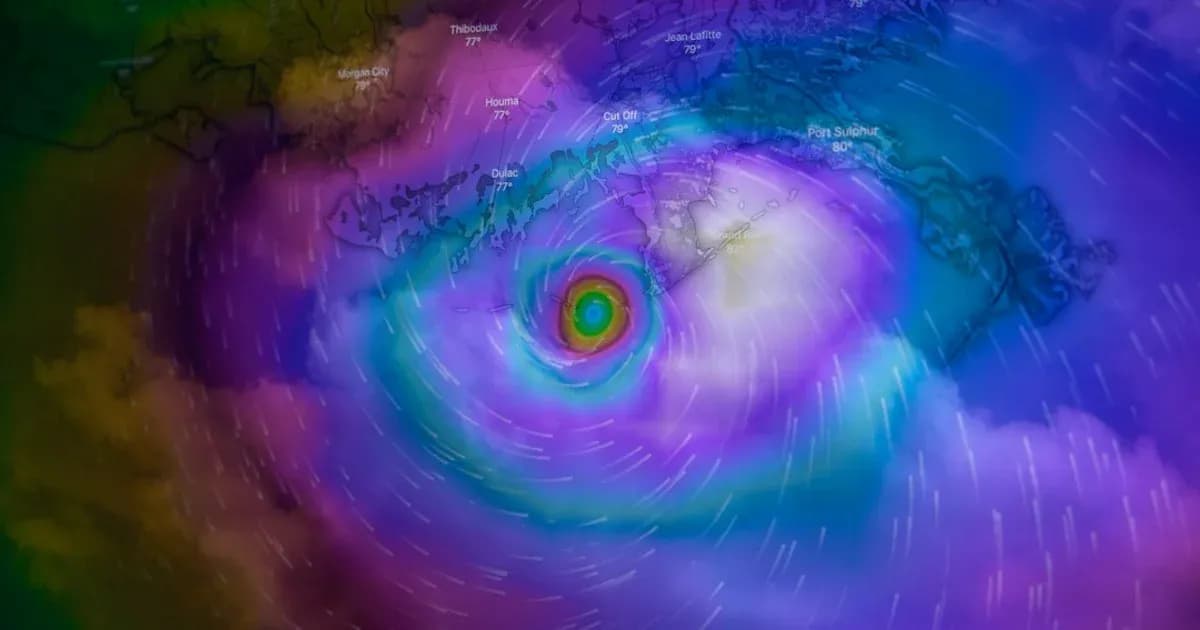
Observation: AI Reshapes Atmospheric Prediction
Google DeepMind recently announced a significant breakthrough: its AI model, GraphCast, predicts weather with greater accuracy and speed than traditional numerical weather prediction (NWP) systems for horizons up to 10 days. This includes a reported 90% accuracy for tropical cyclone track predictions within a 1.4-degree margin of error, often outperforming the European Centre for Medium-Range Weather Forecasts (ECMWF) system, a global standard. A December 2023 study published in Science detailed GraphCast's performance, highlighting its ability to generate 10-day forecasts in under one minute on a single Google TPU v4, a stark contrast to the hours-long computations required by conventional supercomputers.
This development is not an incremental gain. It represents a fundamental shift in how we approach atmospheric modeling. For decades, NWP models relied on complex physics equations and immense computational power to simulate atmospheric processes. And while these models have seen steady improvements, their inherent computational cost and the non-linear complexities of atmospheric dynamics presented persistent challenges to further gains in speed and precision, especially for high-impact events like hurricanes.
Analysis: The Data-Driven structural change
The accuracy of AI models like GraphCast stems from a data-driven approach, different from the physics-based methods of NWP. Traditional NWP systems solve partial differential equations representing fluid dynamics, thermodynamics, and radiative transfer. This requires vast supercomputing resources and a detailed, gridded representation of the Earth's atmosphere, which can introduce computational bottlenecks and approximations that limit resolution and speed.
GraphCast, conversely, operates as a machine learning surrogate model. It learns directly from decades of historical weather data, processing terabytes of reanalysis data from the ECMWF to identify intricate patterns and relationships that govern atmospheric evolution. The model uses a graph neural network architecture, representing the Earth's surface and atmosphere as a graph where nodes correspond to grid points and edges represent spatial connections. This allows it to capture global dependencies and local interactions with remarkable efficiency.
The core advantage lies in inference speed. Once trained, an AI model can generate a forecast almost instantaneously. This means that instead of running a single, high-fidelity NWP simulation over several hours, one can execute multiple AI model runs, or even ensemble forecasts, in minutes. Such speed allows for more frequent updates and rapid assessment of different scenarios, which is crucial during fast-evolving weather events. A 2024 analysis by the World Meteorological Organization (WMO) indicated that AI models could reduce forecast generation time by up to 99% compared to traditional methods for similar accuracy levels.
And, AI models can implicitly account for complex, non-linear interactions that are difficult to parameterize accurately in physics-based models. They excel at pattern recognition, identifying precursors to extreme weather events that might be subtle or distributed across vast geographical areas. But this does not mean physics is discarded. Hybrid approaches, where AI refines NWP outputs or accelerates specific components, are also emerging, marrying the strengths of both methodologies. This allows for a deeper understanding and better prediction of phenomena like hurricane intensification or sudden track changes, which have historically presented significant forecasting hurdles.
Implication: Enhanced Decision-Making for Public Safety
The implications of this AI-driven accuracy for operations managers and public safety decision-makers are profound. Extended lead times for hurricane predictions, even by 24-48 hours, translate directly into critical time for preparedness. For example, a 2023 report by FEMA emphasized that every additional hour of warning can increase evacuation compliance by 5-7%, potentially saving hundreds of lives during a major storm. This offers a tangible reduction in casualties and economic damage.
Consider urban centers. With more precise forecasts, city authorities can optimize evacuation routes, pre-position emergency services, and secure critical infrastructure with greater confidence. This directly aligns with the mission of `urban-intelligence` initiatives, where data-driven insights create more resilient and responsive cities. Knowing the precise landfall probability and intensity allows for targeted resource allocation, preventing over-evacuation or under-preparation, both of which carry significant economic and social costs.
For businesses and supply chains, the ability to anticipate severe weather events with higher fidelity means better continuity planning. Logistics companies can reroute shipments. Manufacturers can adjust production schedules. Agricultural sectors can accelerate harvests or secure assets. This minimizes shift and financial losses, impacting everything from insurance claims to local economies. Shreeng AI's `predictive-analytics` solutions, for instance, are designed to integrate diverse datasets—from environmental sensors to economic indicators—to provide a comprehensive view of potential risks and their cascading effects, enabling organizations to model scenarios and make evidence-based decisions for resilience.
And, the speed of AI-driven forecasting changes the operational tempo of disaster response. Emergency managers can receive updated projections more frequently, allowing for dynamic adjustments to response plans as a storm evolves. This agility is vital. Systems that incorporate `predictive-maintenance`, for example, can use these enhanced forecasts to prioritize preventative checks on critical infrastructure like power grids, communication towers, or flood control systems in the projected path of a hurricane. Proactive maintenance, informed by precise weather intelligence, ensures these systems are prepared *before* impact, reducing downtime and accelerating recovery. This is not about merely reacting; it is about anticipating and preparing with institutional conviction.
Position: The Mandate for Sovereign AI in Critical Forecasting
Shreeng AI holds that the integration of mature AI models into national weather services and disaster management frameworks is not merely an option; it is a strategic imperative. The era of relying solely on computationally intensive, physics-based models for critical, life-saving forecasts is concluding. AI offers a complementary, often superior, capability that can deliver faster, more accurate, and more localized predictions.
But this integration demands careful consideration of data governance and sovereign control. The models that predict national weather events and inform public safety decisions must be transparent, auditable, and subject to national oversight. Dependencies on foreign-controlled AI infrastructure or proprietary models for such critical functions introduce unacceptable risks. Nations must develop or adopt AI capabilities that operate within their own sovereign data ecosystems, ensuring data privacy, security, and uninterrupted access during crises.
Developing and deploying these capabilities requires specialized expertise in data engineering, model training, and operational integration. Shreeng AI is committed to partnering with governments and enterprises to build such foundational `smart-governance-ai` systems. We believe the future of disaster preparedness involves federated AI networks, where national meteorological agencies use highly accurate, explainable AI models—potentially trained on globally available data but deployed and customized for local conditions—to provide citizens with timely, actionable intelligence. This ensures resilience. It ensures safety. And it ensures national autonomy over critical predictive infrastructure. The transition from research to real-world deployment for AI hurricane prediction demonstrates a clear path toward a more prepared, safer future, provided we embrace these advancements with clarity and strategic intent.
Frequently Asked Questions
Sources
- Science: GraphCast: Learning skillful medium-range global weather forecasting
- World Meteorological Organization (WMO): AI in Numerical Weather Prediction
- FEMA: Emergency Management Risk Management Report
Siddharth Patel
Head of Predictive Systems
Builds forecasting engines and early-warning systems for operations, finance, and supply chain use cases.